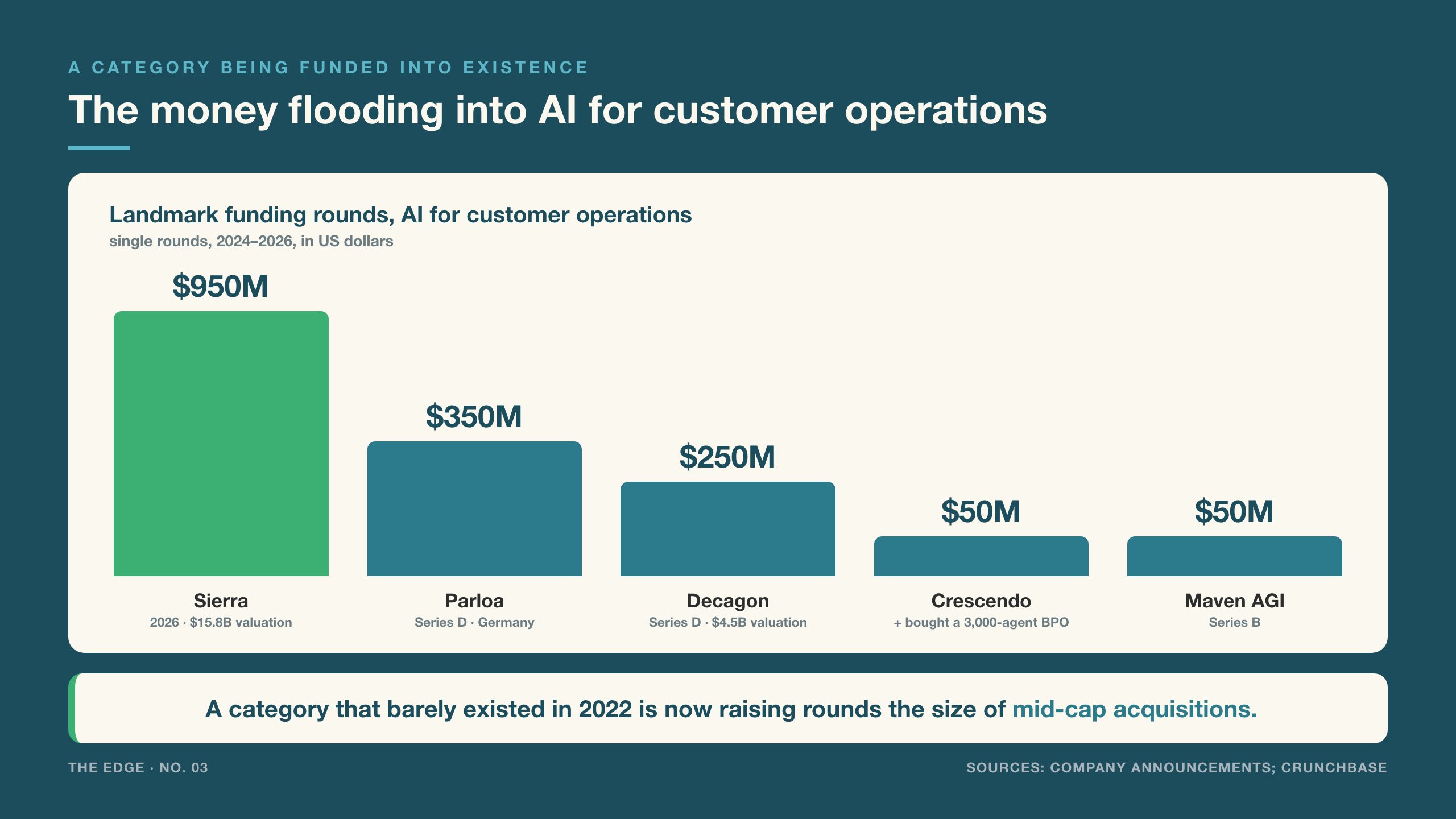
A new category is being funded into existence. AI companies built for customer operations are raising rounds the size of mid-cap acquisitions, signing partnerships with the largest BPOs, and stepping into work that used to belong entirely to people. More than $200 billion went into AI last year, and a meaningful slice is aimed straight at outsourcing. The headlines call it the disruption of the industry. For now, the reality is more modest, and more interesting.
Mostly an add-on, for now
What the loudest of these companies do well, Sierra and Decagon among them, is the easy tier: high-volume, low-complexity support. Read the knowledge base, answer the common questions, deflect the password resets and the order-status checks, fast and around the clock. That is real value. It is also the part of the work that has been automated for a decade through chatbots and self-service. The new wave does it better, and in places does it well enough to retire the human queue rather than assist it. It is still the same tier.
The hard part has not moved
The complex, regulated, multi-language work, the part that needs judgment and carries real accountability, still escalates to a human. So the disruption question comes down to a single test: can these companies climb from the easy tier into the hard one, at a cost and scale that beats the incumbents? That is unproven.
The new wave does the easy work better. It does not yet do the hard work at all.
Cost decides it
For twenty years the outsourcing industry has competed on one number above all others: the price of an hour of labour. Teleperformance, Concentrix and the rest built their margin by moving the work to where wages are lowest, India, the Philippines, parts of Africa and Latin America. That is labour arbitrage, and it has been the engine of the entire offshore model. The cheaper the seat, the stronger the bid.
AI changes the number the industry competes on. When a model handles the contact, the cost stops being a wage and becomes a technology cost: inference, integration, oversight. The marginal cost of one more conversation falls close to zero. A model draws no salary, claims no night-shift premium, and costs no more in Frankfurt than in Manila.
That single shift, from labour arbitrage to technology cost, is what turns Sierra and Decagon from a software upgrade into a direct competitor on the buyer's cost decision. The incumbents win the simple work because their labour is cheap. The new entrants can undercut even cheap labour, because their cost is not labour at all. The contest stops being offshore wages against onshore wages. It becomes human hours against machine cost.
The shift is not uniform. Where the work is simple and the wages are already low, the saving from AI is real but small. Where the work is complex and the labour is expensive, the saving is large. So the economics do not point back at the Philippines. They point at the most expensive, most demanding markets in the world.
Europe is the proving ground
European customer operations are costly to staff, multi-language by default, and heavily regulated. It is the hardest place to serve and the most expensive to run, and that is precisely why it is the test. Three forces make it hard, and an AI that clears all three has proven the model anywhere.
The first is regulation. Europe does not just ask for good service, it asks for certified service. Financial operations fall under DORA, the Digital Operational Resilience Act, in force since January 2025. Data sits under GDPR, with fines reaching four percent of global turnover. The EU AI Act arrives on top, transparency rules from August 2026, high-risk obligations from 2027. For the old regulated industries, banking, insurance, healthcare, the certification burden is heavy and non-negotiable. And the data is not free to roam: personal data on European customers cannot simply leave the European Economic Area, and banking secrecy laws and the regulators' outsourcing rules tightly control where it may be processed. The work cannot be sent wherever labour is cheapest. The United States is lighter and more piecemeal: sector rules like HIPAA, an agency here, a state law there, no single AI regime, and far looser limits on where data can go. A vendor can sell basic support into a US business with little more than a contract. Selling into a European bank means clearing a wall of compliance first.
The second is language. The EU runs on twenty-four official languages, and demand does not stop at the borders: Germany alone carries one of the largest Turkish-speaking populations in the world. Serving these markets well is still a premium requirement, not a solved problem. Translation tools help, but they do not remove the need for genuinely native handling on the work that matters, and a share of in-region, in-language capability remains the price of entry. A model fluent in American English has barely started.
The third, and the hardest, is legacy. Take Klarna. It made headlines announcing that AI now runs its support, the work of seven hundred agents handled by a model. True enough. But Klarna sells small consumer loans, and the support that comes with them is simple: a forgotten password, a login that will not work, the date a payment is due. AI is excellent at exactly that. The tell came next: when the questions turned hard, disputes, account closures, anything emotional or regulated, Klarna quietly brought the humans back.
Now take an old European bank, and a customer asking why a particular charge appeared last month. Answering it means reaching into core systems decades old, in places older than the customer, reading the account history, understanding the fee logic, and resolving the issue, in the customer's own language, inside the rules. Those systems are kept deliberately, because replacing them is costlier and riskier than living with them: when TSB attempted exactly that kind of migration in 2018, it locked nearly two million customers out of their accounts for weeks. That is not a service, it is customer experience, and it is the work that carries the relationship. The forgotten password is the easy part. The disputed charge, wired into a regulated, decades-old back end, is the part almost no one has proven.
Crack Germany and the Nordics, and the rest of the world starts to look easy.
Two strategies, and why one is misread
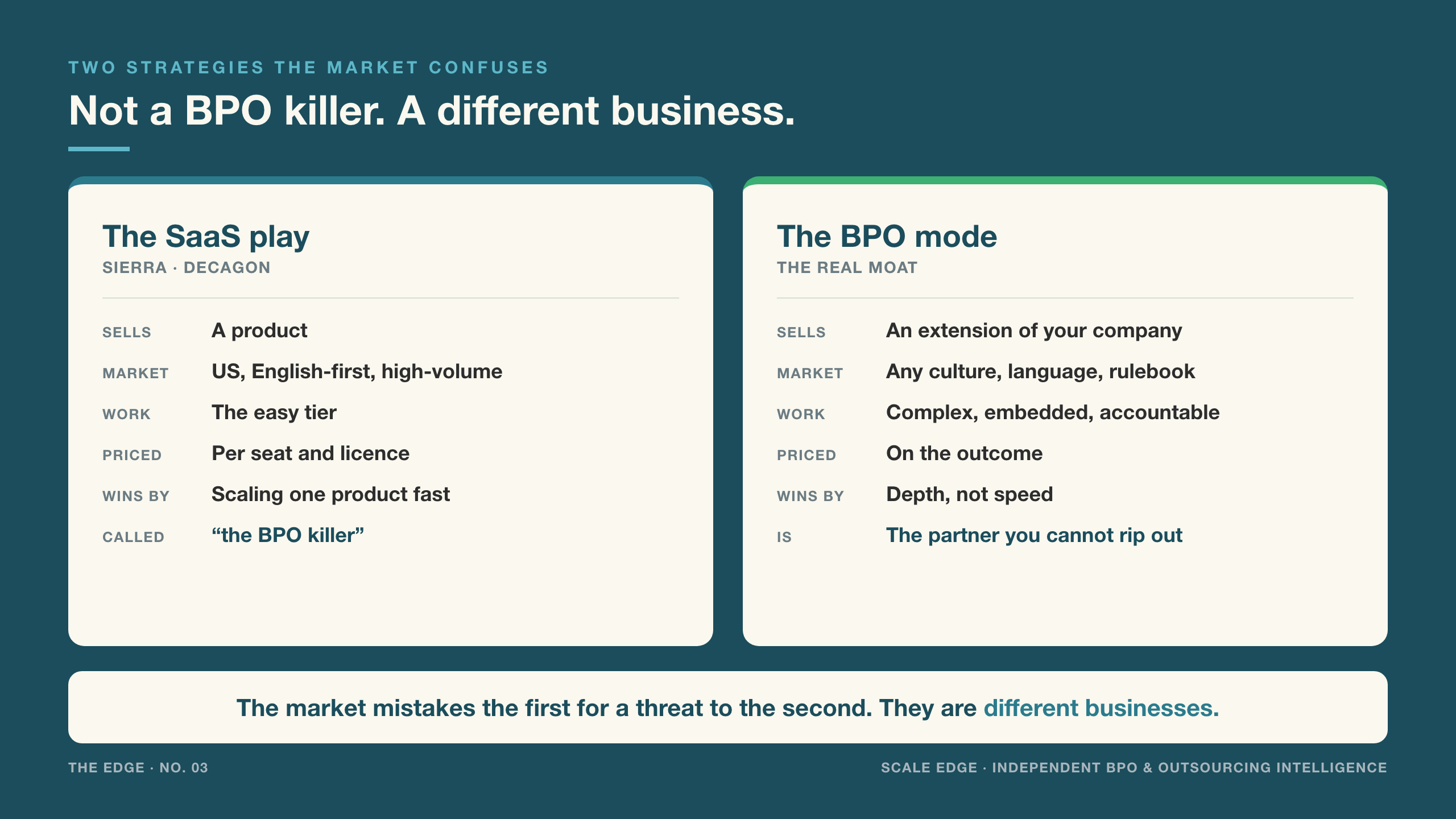
The first strategy is the classic Silicon Valley play, and it is a good one. Build a product, find a sharp repeatable solution, and sell it into the United States, where the market is enormous, English-first, and quick to scale. Sierra and Decagon are running it well: take the high-volume, low-complexity work, grow fast, raise big, and spread the same product across thousands of similar customers. The market has decided this makes them BPO killers. It does not. They are SaaS companies, priced and built like SaaS companies, winning the easy tier. That is a real business. It is not the BPO's business.
Here is the misunderstanding. People picture a BPO as cheap labour in India or the Philippines, answering simple questions at volume for a low price. That part exists, but it is the bottom of the market, and everyone in the industry knows it only scales because the labour is cheap. It is not where the money is. The margin, the volume that matters, and the work that actually sticks all live in the complex tier, and that is the mode the serious BPOs have spent the last decade moving toward.
That mode is not support. It is being an extension of your company: understanding your culture, your customers, your processes and your constraints, then running markets, workflows and solutions you could not run alone. Complexity is not only a European or a regulated problem. An American social platform serving a dozen cultures needs people who understand each of them, the local norms, the sensitivities, the language behind the language, trained on the company's own data and feedback. That is hard, it is valuable, and it is nothing like deflecting a password reset. TELUS and Sutherland are clear examples of the mode: not call centres, but partners embedded deep enough to change how the business runs.
So the two strategies are not fast versus slow. They are two different businesses the market keeps confusing for one. Sierra and Decagon are selling software for the easy tier. The BPO mode is selling judgment, culture and integration for the hard one. An AI that wins the first has proven nothing about the second.
The operator-built wave
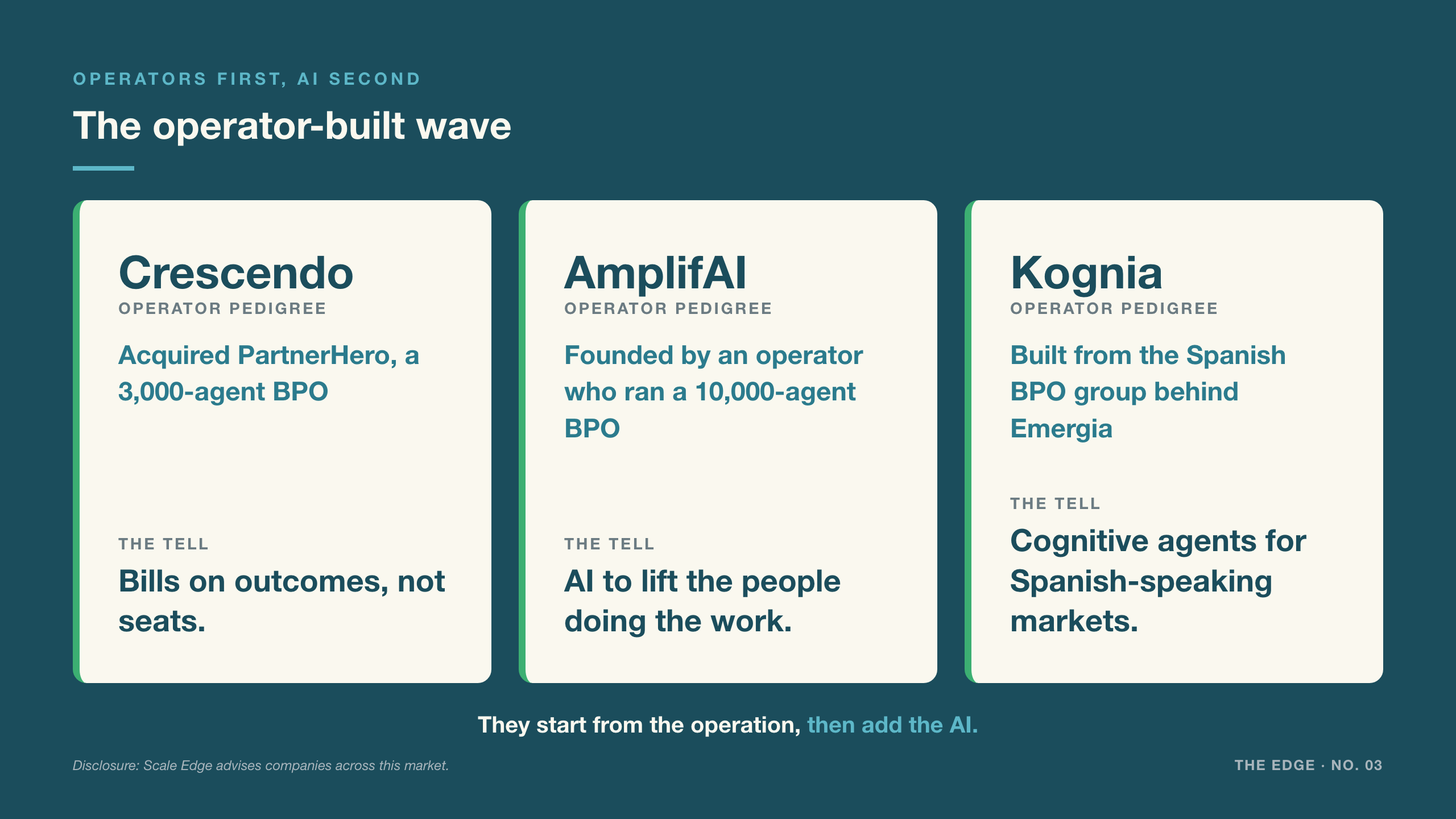
A smaller set of companies is being built the other way around: operators first, AI second. Crescendo, an AI customer-experience platform, acquired PartnerHero, a 3,000-person outsourcer, and now sells a managed service billed on outcomes rather than seats, the client pays when the AI and the human agents hit the agreed quality target. AmplifAI was founded by an operator who ran a 10,000-agent BPO, and builds AI to raise the performance of the people doing the work. Kognia, built out of the Spanish BPO group behind Emergia, is developing cognitive agents for Spanish-speaking markets from an operating base, not a software one. None of them started from a model and hoped it would survive contact with a real, regulated, multi-language operation. They started from the operation.
The verdict: add-on or disruptor
Both, and the split is not where the headlines put it.
The Silicon Valley pure-plays, Sierra and Decagon, are an add-on today. They are excellent, priced like software, and growing fast on the easiest large market in the world: the United States, English-first, high-volume. In that market they are already strong enough to retire people on the simpler work, not merely assist them. What they have not proven is the crossing, that the model holds up in the hard markets, multi-language and heavily regulated, where a wrong answer carries legal weight and where the incumbents still earn their margin. Until that is proven in production, a better add-on is still an add-on.
The disruptors are the names almost no one is putting on a slide. The operator-built wave, Crescendo, AmplifAI, Kognia, starts from the operation and adds the AI, which means it is built around the exact complex, accountable work the pure-plays route around. These are the companies positioned to carry the shift from labour arbitrage to technology cost into the work that actually pays. If the model of the industry is disrupted, the disruption comes from here, not from the US volume players.
That is the call. The loudest names are an upgrade to what already existed. The quiet operators are the threat to the model itself.
How to choose, and what to get right first
The instinct, once the landscape is clear, is to start calling vendors. That is the mistake. The decision does not start with a vendor. It starts with you, and with four questions that all come before the first sales call.
What you actually need. Not what is being sold. Map the work you want handled: which queues, which volumes, which outcomes. The fact that a vendor can replace people on a queue does not mean you should. Some work is cheaper, safer, or simply better kept human. Decide what problem you are solving before anyone offers a solution.
What stage you are at. A company running ten agents and a company running ten thousand are not buying the same capability. Maturity, data, volume and complexity all change the answer. The right partner for where you are now can be the wrong one in two years, and the reverse.
The maths. Model the real cost before you set a budget. The headline saving is rarely the real one once integration, oversight, and the work that still escalates to a human are counted. Replacing people changes the cost structure, it does not erase it. Get the budget right by getting the maths right first.
The contract. Structure the commercials around your outcome, not the vendor's revenue. Per seat and per licence protects the vendor. Priced on the resolved contact, or the quality target met, protects you. The contract is where risk is shared or quietly handed back, and it is settled before you sign, not after.
Get those four right and the vendor conversation becomes simple. Get them wrong and the best vendor in the world will still sell you the wrong solution.
Because here is what no vendor will tell you: every one of them will say yes. Ask Sierra, ask Decagon, ask any operator on this page "can you do this for us?" and the answer is always yes, we can. That is not dishonesty. It is sales. And it is exactly why the decision cannot start, or end, with the people selling to you. It needs someone with no stake in which one you choose.
That someone is Scale Edge. Independent intelligence for the buy side of outsourcing. No vendor sponsorship, no commissions, no kickbacks, no agenda except yours. Scale Edge tells you what you actually need, what it should cost, and which partner can genuinely deliver, then holds them to it.
If you are choosing, renewing, or rethinking a vendor this year, talk to someone independent before you talk to a single vendor. The first conversation is free. Message Victor Manzanera here on LinkedIn, or write to info@scaleedgegroup.com, and find out what the right decision looks like for your company.
Sources
Crunchbase (AI venture funding, 2025); company announcements and Crunchbase for the funding rounds of Sierra, Parloa, Decagon, Crescendo and Maven AGI; Crescendo's acquisition of PartnerHero (company announcement, 2024); public company information on AmplifAI, Kognia and Emergia (Grupo Valora); public disclosures for Teleperformance and Concentrix delivery footprints; DORA (ESMA and EBA), GDPR and the EU AI Act (EU Commission); GDPR, the EBA Guidelines on outsourcing and Regulation EU 2018/1807 on data location; the public record on the EU's twenty-four official languages and Germany's Turkish-speaking population; industry reporting on COBOL in banking systems; Klarna press, OpenAI and CX Dive on Klarna's use of AI; and public reporting on the 2018 TSB core migration.