Every analyst, every vendor, every conference panel now says the same thing: the old way of buying outsourcing is dead, and the future is paying for outcomes. They are right about the direction and silent about the problem. Nobody buying or selling can yet answer the first question an outcome-based contract asks, which is what an outcome costs. The market has agreed on the destination and has no map.
The model everyone is abandoning
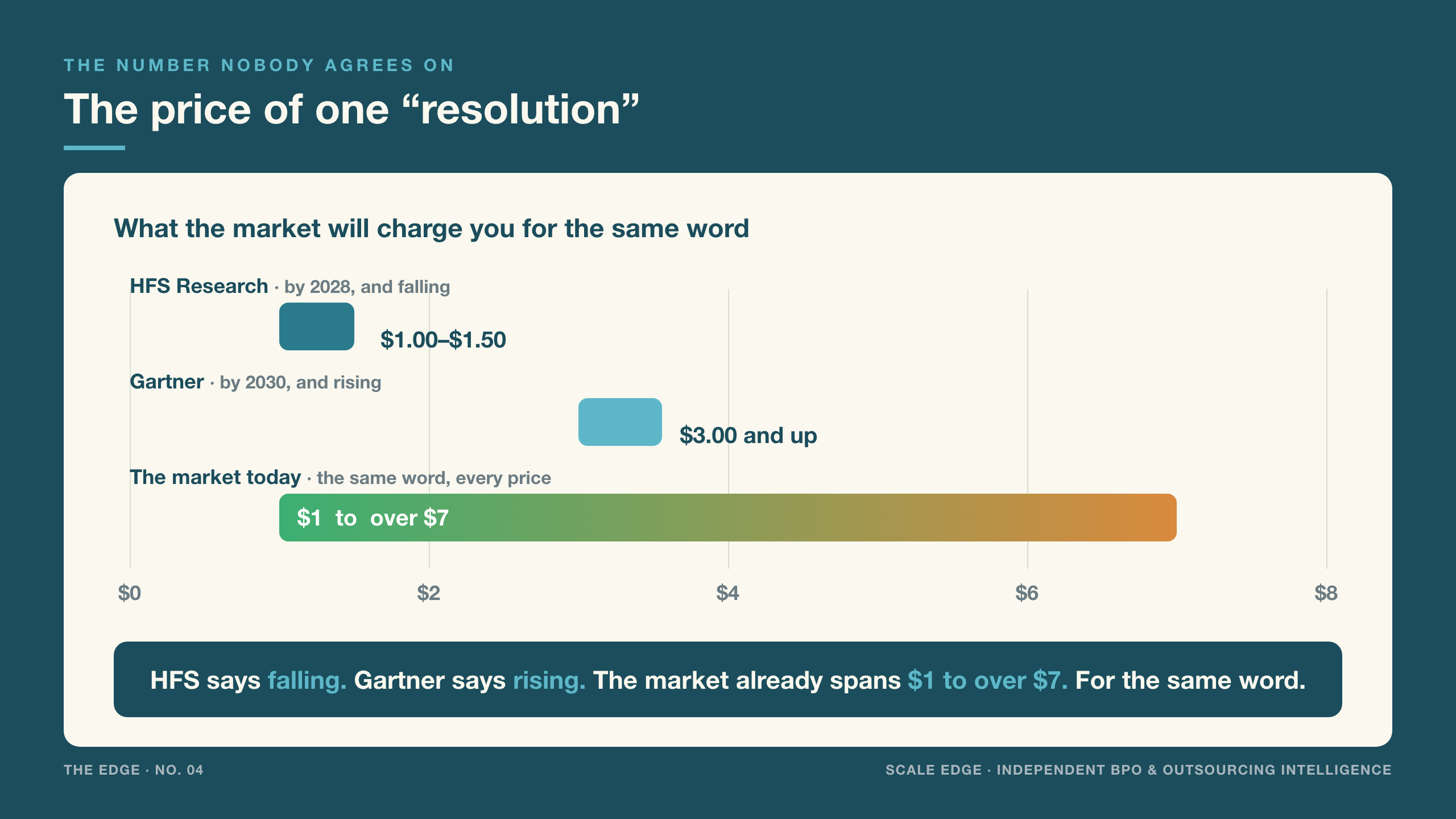
For twenty years the industry priced one thing: an hour of labour. Per seat, per agent, per full-time equivalent. It was simple, it was auditable, and it rewarded exactly the wrong behaviour, more hours, more headcount, more tickets, never fewer. The buyer paid for activity and hoped for a result, and the vendor was paid the same whether the customer left happy or left entirely. The incentive ran backwards. A vendor that resolved every issue on first contact, cutting volume in half, would cut its own revenue in half with it. The model quietly punished the very thing the buyer wanted.
The drift away from it is not new, and the numbers show how slow it has been. In HFS Research's analysis of more than two thousand live contracts, the share priced purely on labour fell from around two-thirds in 2008 to just over half by 2014, with gain-share, transaction-based and hybrid models taking the difference. The direction has been clear for fifteen years. The pace has been glacial. Most of the market talked about moving and stayed exactly where it was.
What changes now is that AI breaks the unit the old model rests on. When a model handles the contact, there is no seat to count and no hour to bill. The cost moves from a wage to a technology cost: inference, integration, oversight, none of which sit on a timesheet. The old invoice stops describing the work. A contract that bills for agent-hours becomes incoherent the moment the agent is software, and every vendor knows it. So the industry is finally reaching for a new unit, under real pressure this time rather than as a slide. The trouble is that it has reached for several at once, and they do not agree with each other.
The number nobody agrees on
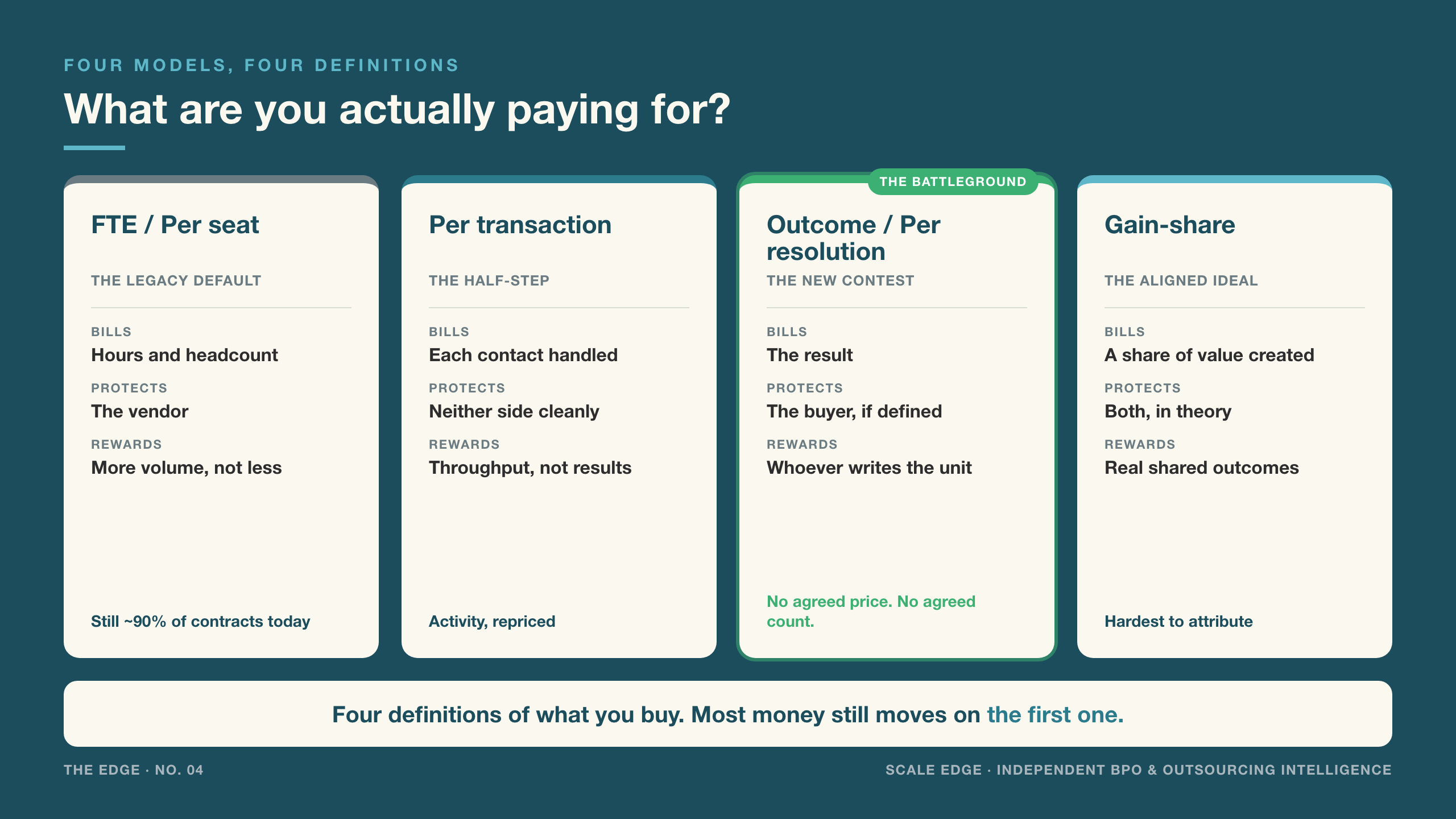
Here is how unsettled it is. Two of the biggest analyst houses in the industry published per-resolution forecasts within months of each other, and they do not agree on the price or even the direction it is heading. HFS Research puts routine interactions at one dollar to one dollar fifty per resolution by 2028, and sees the number falling as the models mature and unit costs drop. Gartner puts it above three dollars by 2030, higher than many offshore human agents, and sees it rising, pushed up by data centre costs, the pivot from subsidised growth to profitability, and complex cases that burn more tokens. Same unit, two respected houses, opposite conclusions. The buyer being told to move to outcome-based pricing is being handed a number that one authority says will halve and another says will triple.
And the forecasts are the tidy part. In the live market the price of a single resolution already ranges from under a dollar to more than seven, for the same word. The smart objection is that it depends, on the complexity, the case, the industry, the volume, and that is correct. It is also the problem. The number moves so far across so many factors that no published figure tells a buyer what their own work should cost.
The reason the numbers scatter so widely is that the word hides the disagreement. Two vendors can both quote a price per resolution and mean almost nothing in common. One counts a resolution the moment the AI sends a reply the customer does not immediately reject. The other counts it only when the issue is confirmed closed, no repeat contact within seven days, no escalation, no complaint. The first vendor will quote a low number and bill a high volume, because almost every contact resolves under its definition. The second will quote a higher number on a fraction of the volume. Read only the price and the cheap one wins. Read the definition and they may cost the buyer the same, or the cheap one may cost more, while delivering worse service. The unit looks standard. It is anything but.
And the move everyone describes as already happening, mostly has not. HFS estimates that roughly ninety percent of outsourcing engagements are still priced on labour, even though two-thirds of buyers say they would rather pay for outcomes. Sit with that gap. The overwhelming majority of buyers want one model, and the overwhelming majority of contracts run on the other. That is not a market mid-transition. It is a market that has agreed where it wants to go and has not found a way to get there, because the moment anyone tries to write the outcome down, the questions in this edition appear and the deal stalls back onto a per-seat rate everyone can at least agree how to count.
The market has agreed that outcome-based pricing is the future. It has not agreed what an outcome costs, or how to count one.
Who owns the outcome
Suppose the price is settled. The harder problem is still waiting, and it is the one that quietly sinks these contracts: attribution. An outcome-based deal pays the vendor when a result is achieved. So you have to be able to say the vendor achieved it, and on the work that matters that is rarely clean.
Walk through a single resolved contact. A customer messages about a charge they do not recognise. The vendor's AI answers, explains the fee, and the customer leaves satisfied. A resolution, on the invoice, billed to the vendor. But look at what actually produced it. Your team wrote the knowledge article that explained the fee. Your billing system is the reason the charge looked strange in the first place. Your historical contact data is what trained the model to recognise the question. The customer was calm because your brand had already earned the benefit of the doubt. The vendor supplied the last step in a chain you built. It is paid in full for the whole result.
Now run it the other way. The same AI gives a wrong answer, the customer disputes the charge, the case escalates, and your own team spends an hour cleaning it up. Under a per-resolution model, who absorbs that cost? If the metric only counts wins, the vendor keeps every easy resolution and the buyer silently funds every failure. Everest Group named this at the start of the year, calling attribution the central unsolved question of outcome-based metrics, and it is unsolved because most of the value in complex service is shared, not delivered by one party. Pay on a result you cannot cleanly attribute, and you are not sharing risk. You are funding the vendor's luck and insuring its mistakes.
Why outcome-based is not automatically on your side
It is sold as the buyer-friendly model, and it can be. It can also be the opposite. There are two failure modes, and both are common enough to name.
The first is risk transfer. An outcome unit lets the vendor get paid on the resolutions it claims while quietly routing anything hard, slow, or expensive back to your own team. The contact that needs judgment, the case that escalates, the customer who is angry, all of it flows out of the vendor's metric and into your operation. The vendor keeps the clean numbers and the clean invoice. You keep the mess, and you keep paying for the staff to handle it, on top of the outcome fees. The headline rate looks like a saving. The total cost of running the relationship goes up.
The second is cherry-picking. The model bills happily on the easy tier, where a resolution is simple to claim and volume is high, and leaves the complex, regulated, judgment-heavy work, the work that actually carries your customer relationship, outside the metric entirely. You end up with a glowing resolution rate on password resets and order-status checks, and no commercial coverage at all on the disputes, the complaints, and the regulated cases where a wrong answer carries legal weight. The number on the dashboard is green. The part of the service that decides whether customers stay is not being priced, measured, or owned by anyone.
Outcome-based pricing is not a safer contract by default. It is a different contract, with a different set of places for risk to hide. Whether it protects you or the vendor is decided entirely by how it is written, not by the label on it. The same three words, priced per outcome, can describe the best deal you will sign this decade or the worst.
Four questions to settle before you sign anything outcome-based
The instinct, once you are convinced the model is changing, is to call vendors and ask for their outcome-based pricing. That is premature, and it hands the vendor the one advantage you cannot afford to give away, the right to define the terms. Settle these four first, in your own words, before anyone quotes you a number.
Define the unit. Write down exactly what one outcome is before a vendor does it for you. A resolution, by whose definition, measured how, confirmed by whom, and held for how long before it counts. A resolution that is closed the instant a reply is sent is a different product from one that holds for seven days with no repeat contact and no escalation, and the two should not carry the same price. If the vendor writes the definition, the vendor controls the invoice, and every ambiguity will resolve in the vendor's favour. The definition is the contract. Everything else is detail.
Define attribution. Decide, in advance and in writing, what share of the result the vendor is actually being paid for, given that your knowledge, your data, and your product all sit inside every resolution it claims. Agree what happens to the value that is plainly shared, and agree what happens when the vendor's answer is wrong and the cost lands on your team. Attribution gets settled in the contract or it gets settled in a dispute eighteen months later, when the relationship is already strained and the leverage has moved. Choose the first.
Define the floor. Specify what happens on the work the outcome metric does not cover, the escalations, the complex cases, the regulated exceptions, the contacts that resolve nowhere clean. This is the work that does not disappear under any pricing model, and if the contract is silent on it, it becomes an uncosted liability that grows quietly until it is the largest line in your operation. Price the exceptions deliberately, before they price you.
Define the exclusions. Know precisely which work sits outside the outcome unit, and make certain it is not the work that matters most. A clean resolution rate on the easy tier can sit on top of a failing service on the hard one, and the dashboard will stay green the entire time customers are leaving. List what the metric does not touch, look hard at that list, and ask whether the part of the service that actually keeps your customers is on it. If it is, the contract is measuring the wrong thing well.
From the Network
This is the question Scale Edge has spent the past months inside. Reading live outsourcing contracts against what each buyer was actually promised, the pattern is consistent enough to build a method on: how to price an outcome without quietly handing the risk back. That framework publishes on 25 June. This edition is the problem. The paper is the method.
One move this week
Before your next vendor conversation, write down your own definition of one resolved outcome, in a sentence, and the price you think it is worth. Take it into the room. The gap between your number and theirs is the negotiation, and the side that wrote the definition wins it.
Independent intelligence for the buy side of outsourcing. No vendor sponsorship, no commissions, no agenda except yours. Scale Edge tells you what the work should cost, how the contract should be built, and which partner can genuinely deliver, then holds them to it.
If you are pricing, renewing, or rethinking an outsourcing contract this year, talk to someone independent before you sign. The first conversation is free.
Sources
HFS Research / Phil Fersht, Horses for Sources; HFS BPO Pricing Evolution study of more than two thousand contracts; HFS Research per-resolution forecast (Genpact FOCUS 2026 coverage); Gartner press release, 26 January 2026; Everest Group, "Outcome-based metrics: the new value currency in BPO," January 2026; and live per-resolution vendor pricing pages including Intercom Fin, Zendesk, Salesforce Agentforce and Crescendo, 2026.