Every outsourcing conversation now opens with the same promise. Buy the AI, cut the cost of service. The technology is real and the savings are real, and yet across most of the market the money keeps not arriving. When it does not, the reflex is to blame the vendor's model. The reflex is wrong. The constraint is almost never the technology. It sits inside the building of the company that bought it.
The savings that never arrive
The pattern is familiar enough now to be predictable. A buyer signs for a headline saving. The pilot looks good. Then the rollout stalls, the saving shrinks, and the business case gets quietly rewritten to something softer than the one that justified the deal. The vendor's AI did what it said on the narrow task it was shown. The result still did not show up at the scale anyone promised.
The reason the pilot misleads is that a pilot is run on the best version of the operation. A small, clean slice of data is prepared for it. A motivated team is put around it. The hard cases are set aside as out of scope for a first phase. Under those conditions the model performs, the demo lands, and the saving is extrapolated across the whole operation as if the whole operation looked like the pilot. It does not. Production is the part that was held back from the pilot, the messy data, the unmotivated team, the exceptions that were declared out of scope. The model meets the real operation for the first time at rollout, which is exactly when the saving was supposed to start, and that is when it quietly stops being achievable.
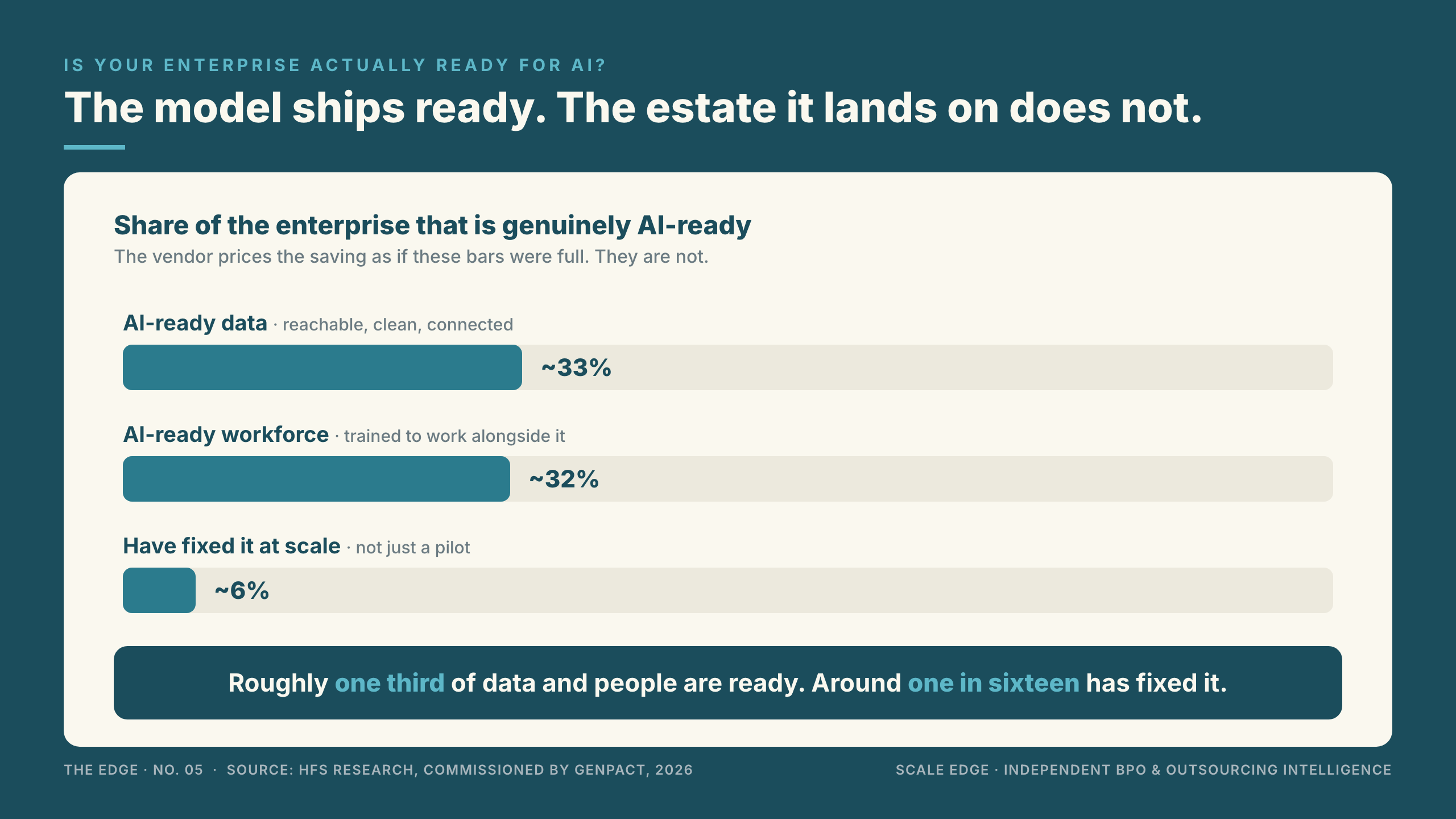
Research published this month put a hard number on why. In an analysis by HFS Research, commissioned by Genpact, only about a third of enterprise data was found to be in a state an AI can actually use. Only about a third of the workforce was ready to work alongside it. And roughly one organisation in sixteen had done the work to fix either at scale. The technology arrives ready. The estate it lands on does not.
The bottleneck is in your building
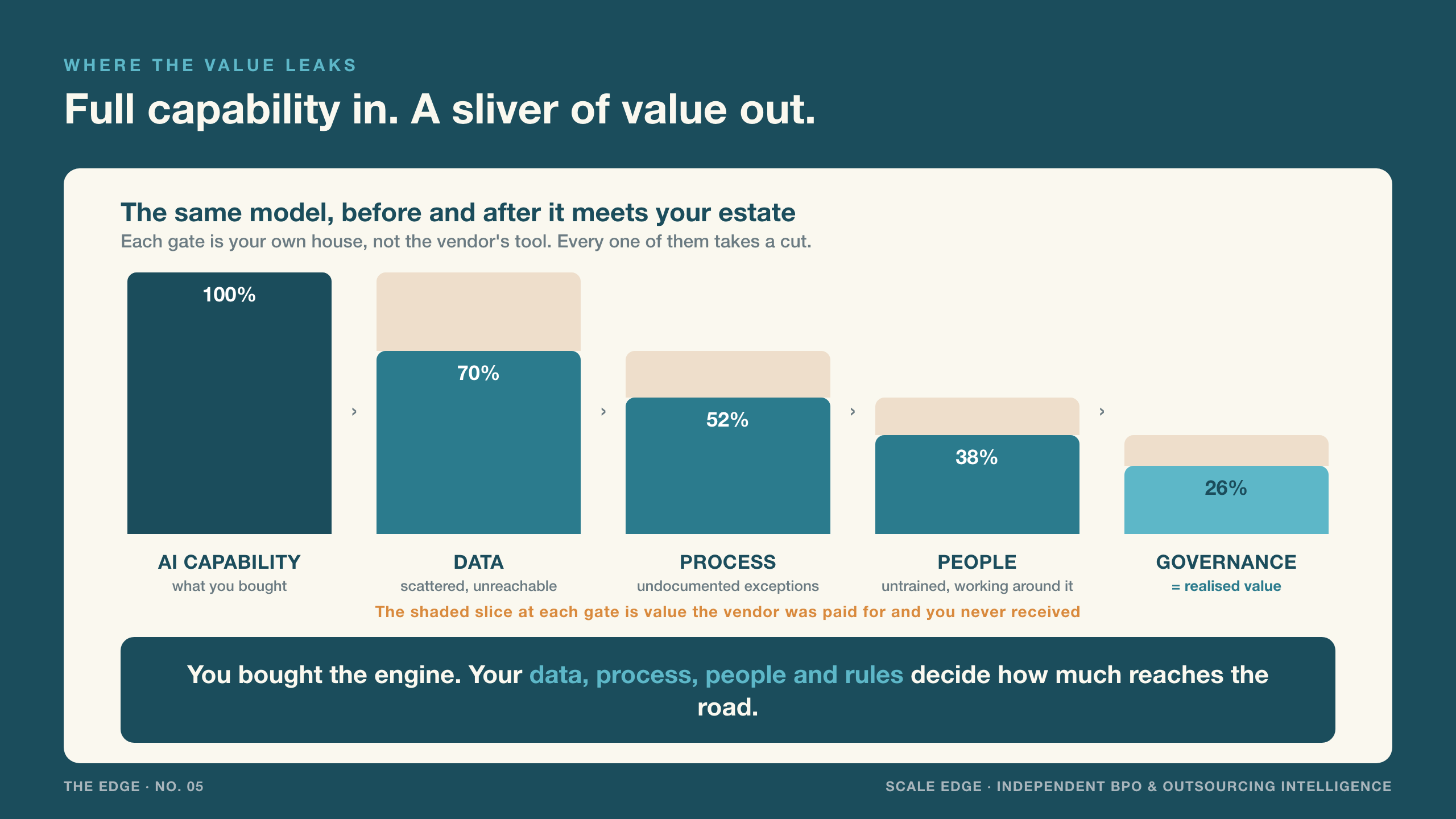
An AI is only as useful as the estate it runs on can absorb. Walk the path a vendor's model actually has to travel inside a real company and the losses are obvious at every step. The data is scattered across systems that do not talk to each other, so the model cannot reach half of what it needs. The process it is asked to automate is the written one plus a hundred exceptions nobody ever documented, so it handles the easy cases and breaks on the rest. The people are not trained to work with it, not incentivised to trust it, and quietly working around it, so the tool sits idle while the headcount stays. And there are no rules for what the model is allowed to decide on its own, so every borderline case routes back to a human anyway.
Make it concrete. A company automates a refunds process, the kind of high-volume, rules-based work AI is supposed to own outright. On paper it is simple. A customer requests a refund, the policy is checked, the money is returned. The vendor prices a steep saving against the headcount that runs it today. Then the model meets the actual operation. The order data sits in one system, the payment data in another, and the two were never reconciled, so the model cannot confirm half the purchases without a human pulling records by hand. The written policy has nine exceptions the team applies from memory and a tenth they invented last quarter for a major client, none of them written down anywhere the model can read. The agents, sensing where this is heading, stop feeding the tool the edge cases and resolve them quietly off to the side, so the data the model learns from gets cleaner and less representative every week. Within two quarters the refunds AI handles the easy third of the volume that was never expensive in the first place, and the team that was supposed to shrink is still there, now also babysitting the tool. Nothing the vendor sold was false. The saving still evaporated, because every place it was supposed to come from was a part of the company's own house that was not ready.
What goes in as full capability comes out as a sliver of realised value. And there is a sharper version of the problem hiding inside it. Pointed at a broken process, AI does not fix the process. It runs it faster. You automate the mess, accelerate it, and call it transformation. The saving was never going to come from the tool. It was always going to come from the work around the tool, and that work is the part nobody sold you.
The vendor sells you the engine. The mileage is decided entirely by the road you already own.
Why no vendor will tell you this
The vendor sells the tool. The readiness work, cleaning the data, documenting the real process, retraining the people, writing the governance, is slow, unglamorous, and entirely yours. No vendor wins a competitive deal by telling a buyer the actual project is months of internal housekeeping before the AI earns a cent. So the pitch stays where it sells. Our model cuts thirty percent. Against an estate that cannot absorb it, a number like that is true in the demo and fiction in the contract. The saving is quoted on the vendor's tool. It is delivered, or it is not, by your house. The quote and the result are measured on two different sides of the table, and only one of them shows up in the sales deck.
There is also a structural reason the readiness problem stays invisible until it is too late. The work that would fix it is not work the vendor can bill. Cleaning a buyer's data and rewriting a buyer's broken process does not sit on the vendor's product roadmap and rarely sits in the vendor's commercial interest, because a buyer who fully understood how much of the estate had to change before the tool could earn out might never sign in the first place. So the incentive on the sell side is to keep the conversation on the capability of the model and away from the condition of the estate. The demo runs on tidy sample data precisely because tidy sample data is the one environment in which the headline number is real. The buyer sees the tool perform and assumes the performance will travel. It does not travel on its own. It has to be carried, by readiness work the buyer has not scoped, costed, or even been told about, and the first anyone hears of it is when the saving fails to arrive.
What to settle before you buy
The instinct, once the cost case looks compelling, is to call vendors and ask for their AI pricing. That is premature. Settle these on your own side first, because every one of them decides whether the saving is real before a vendor is ever in the room.
Audit the data. Know what state your data is in before any vendor demo, because the model is trained and priced on the assumption it can reach all of it. Is it clean, connected and reachable, or scattered across systems that do not speak to each other and contradict one another where they overlap. If the model cannot get to your data, or cannot trust it once it does, the saving is theoretical and the demo was a magic trick run on tidy sample records. Run the audit first, on your own, and price the work to fix what it finds. The data audit is the first line of the project, not a footnote to it, and it is the single best predictor of whether the saving will ever appear.
Map the process honestly. The process you are about to automate is rarely the process as written. It is the written one plus the exceptions your team absorbs by hand every day without telling anyone, and those exceptions are usually where the cost and the risk actually live. AI runs the documented path cleanly and stalls on everything outside it, which means the part of the work that was expensive is also the part that does not get automated. Map the real process, exceptions included, before you let anyone price automating it. If your own team cannot describe the process end to end, including the cases they handle from memory, you are not ready to buy a tool that runs it. A process you cannot describe is a process you cannot automate.
Ready the people. Software does not save money on its own. People working differently around it do, and people are the part of any operation most resistant to working differently. If the workforce is not trained on the tool, not incentivised to trust its output, or quietly routing around it to protect their own judgment, the licence gets paid, the headcount stays, and the saving lands nowhere. The change management is not a soft add-on to the project. It is the mechanism by which the saving is actually realised. Budget it, staff it, and start it before the tool arrives, not after the saving has already failed to show. The cheapest model on the market saves nothing if nobody changes how they work.
Decide who owns the outcome. Agree, in writing, who is accountable when the saving does not appear. This is the line that gets skipped, because in the optimism of signing nobody wants to plan for the result falling short. If the vendor is paid for its tool performing on a narrow task while you are left holding everything the tool cannot reach, the contract has quietly handed the vendor the upside and you the risk, and no one named it out loud. The outcome has to belong to someone with both the authority and the budget to fix the estate when it is the estate that is failing. Make certain it is named before you sign, not argued over a year later when the saving is missing and the leverage has moved.
From the Network
This is the line Scale Edge has spent the past months on, reading live outsourcing contracts against what each buyer was actually promised. The most consistent finding in the set is an uncomfortable one. When an outsourced relationship underdelivers, the cause sits on the buyer's side of the line far more often than the vendor's, and the contract is almost never built to see it, let alone share it. Designing a relationship that does not quietly route the risk back to the buyer is a discipline, and it is the method Scale Edge publishes next. This edition is the problem. The paper is the method.
One move this week
Before your next AI conversation, pick one process you are tempted to automate and write down, honestly, the real state of the data underneath it and the exceptions your team handles by hand. One page. That page is the true scope of the project. Take it into the room. The vendor will quote you the tool. You will be the only person there who knows what it actually has to land on.
Independent intelligence for the buy side of outsourcing. No vendor sponsorship, no commissions, no agenda except yours. Scale Edge tells you what the work should cost, how the contract should be built, and which partner can genuinely deliver, then holds them to it.
If you are pricing, renewing, or rethinking an outsourcing contract this year, talk to someone independent before you sign. The first conversation is free.
Sources
HFS Research, commissioned by Genpact ("trapped AI value" research), 2026: about a third of enterprise data is AI-ready, about a third of the workforce is AI-ready, and roughly one organisation in sixteen has addressed it at scale.