When a budget tightens, the outsourcing reflex is always the same. Find a cheaper seat. Move the work to a lower-cost geography, sign a lower rate, book the saving on the spreadsheet before the quarter closes. The public markets are now running a slow, expensive demonstration of where that reflex leads, and most of the commentary around it has reached for the easy explanation rather than the accurate one.
What the market is actually pricing
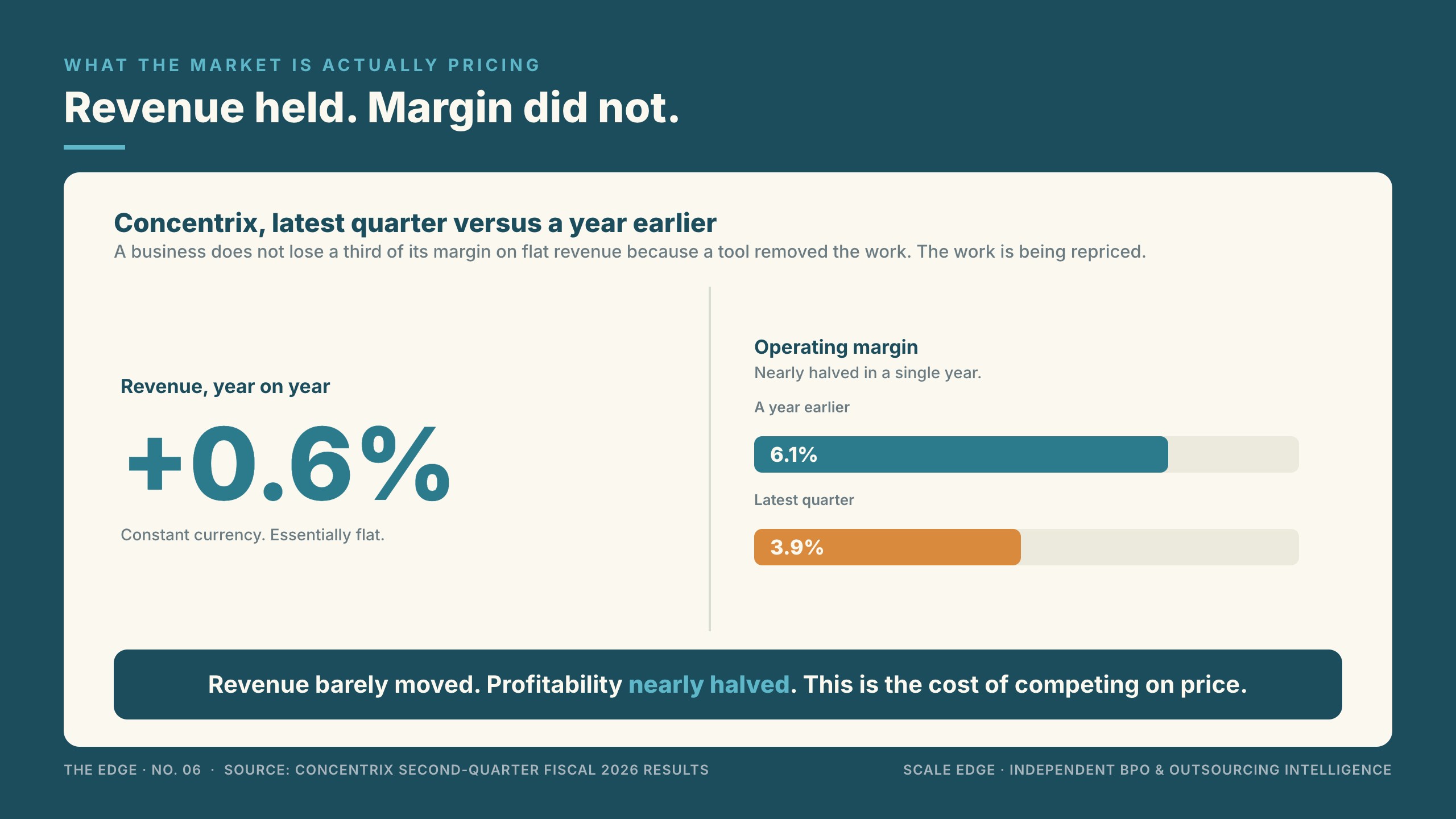
Start with the company that reported this week. Concentrix, one of the largest operators in the industry, posted a quarter in which revenue held almost flat, up less than one percent year on year in constant currency, while profitability did not hold at all. Operating margin fell from 6.1 percent to 3.9 percent of revenue in a single year. The company cut its full-year earnings outlook, and the reasons it gave were faster offshoring and clients reallocating where they spend. Step back from the quarter to the year, where the signal is cleaner than any single day, and the share price has fallen by more than half over the past twelve months. The convenient headline writes itself. Artificial intelligence is hollowing out the contact-centre business.
The more useful reading is in the distance between two of those numbers. Revenue barely moved. Margin nearly halved. A business does not lose a third of its operating margin while holding its revenue because a technology quietly deleted the work. It loses it because the work is being repriced. Buyers are moving volume to cheaper locations and pressing harder on rate, and the provider is absorbing the difference in order to keep the revenue on the books. The picture is not a market being automated out of existence. It is a market competing on price, and beginning to find out what competing on price actually costs.
That dynamic does not originate on the vendor's income statement. It is the cumulative result of a decision made on the buyer's side of the table, in procurement reviews and renewal negotiations, thousands of times a quarter. Take the cheaper seat. The compressed vendor margin is the buyer reflex, read back from the other side of the contract.
This is not one company
It would be comfortable to treat all of this as one provider's execution miss. The wider market does not support that reading. The pressure is showing up across the cohort whose business model is the same at its core, selling the largest possible volume of qualified seats from the lowest possible cost locations.
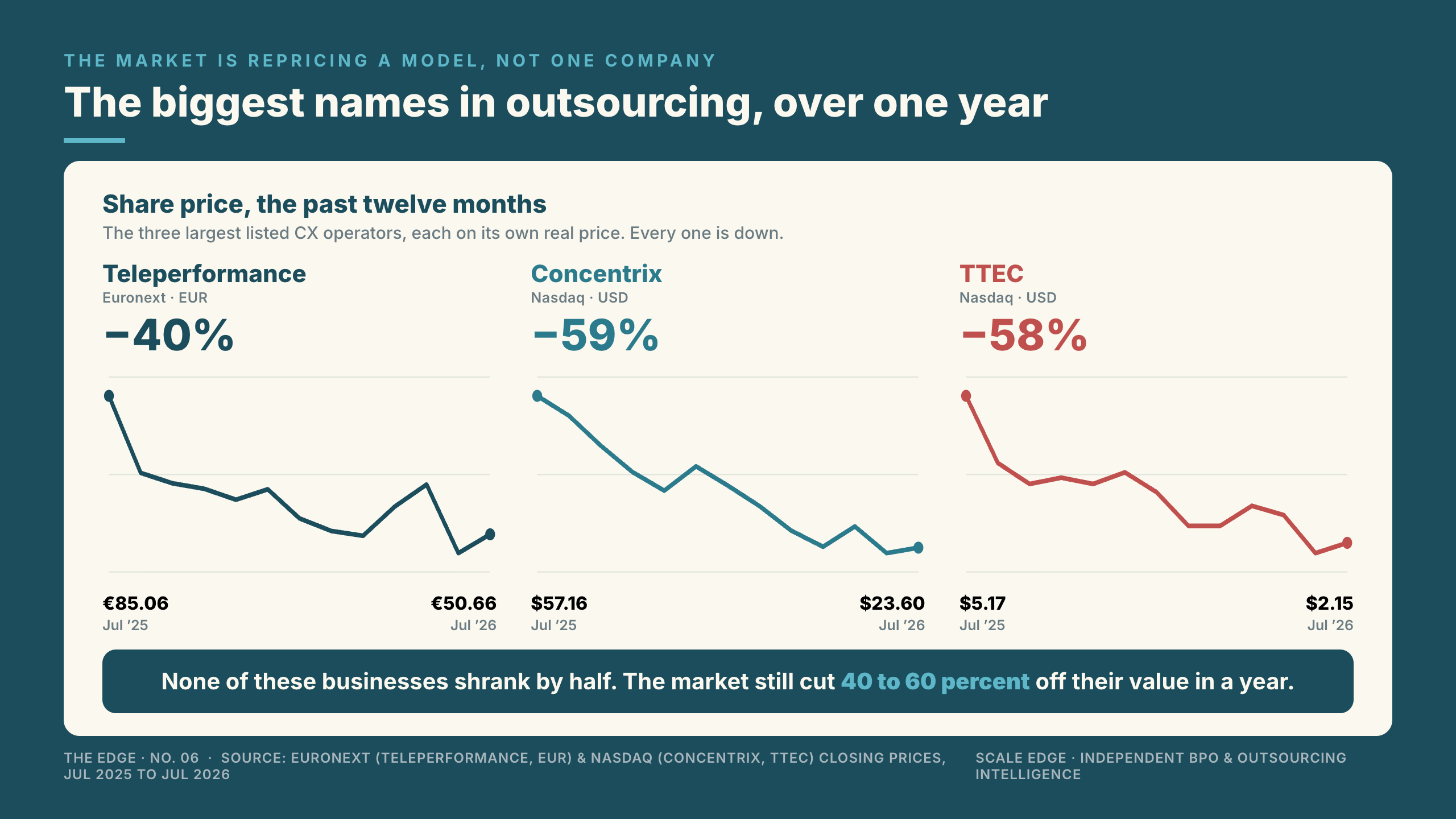
The largest operator in the sector, Teleperformance, has spent the better part of two years derating, and the operating numbers underneath the share price tell the same story as the price itself. Its core services margin contracted sharply through 2024 on barely positive growth, group revenue slipped in 2025, and like-for-like revenue declined again in early 2026. It is not alone. Measured over the past year, the share prices of the largest listed operators have fallen together. Teleperformance, the world's number one, by about forty percent. Concentrix, the number two, by nearly sixty. TTEC by about the same. The two other members of the industry's top tier, Foundever and Alorica, are privately held and publish no share price, but nothing in the public record suggests they have escaped the same squeeze. Different tickers, the same shape. Revenue under pressure, margin under more pressure, valuation under the most pressure of all. The market is not pricing a single bad quarter. It is repricing a model.
The reason is structural, and it is worth stating plainly because it is the part the AI headline skips. When an entire field competes on the same axis, and for this cohort that axis is the rate per seat, price is the only variable left to give. There is no durable margin in being the cheapest qualified seat at scale, because the next provider can always quote a slightly cheaper one, and the buyer, comparing on rate, will take it. Artificial intelligence has sharpened the squeeze by giving buyers a credible reason to demand still less for the same work. It did not create the squeeze. The squeeze is what happens to any business whose customers have been trained to buy on a single number, and the outsourcing industry trained its customers to buy on rate for thirty years. The bill for that training is now arriving on the sell side, in public, in the share prices of the firms that taught it.
For a buyer, that is not vendor news to be observed from a distance. It is a mirror.
The reflex, and why it is seductive
The pull toward the lowest rate is not irrational. It is the cleanest saving a leader can show. A rate is a single number. It is comparable across vendors on one line of a spreadsheet, it survives a board slide without a footnote, and it can be defended in a procurement review with no further work. Move a seat from a higher-cost location to a lower-cost one and the gap is immediate, large, and easy to attribute to the person who signed for it. Crucially, nothing inside the buyer's own operation has to change for the number to look real. Set against the slow, unglamorous work of redesigning a process or repairing the data underneath it, signing a cheaper rate is the saving that asks nothing of you.
That is precisely why it misleads. The rate is the one cost in the relationship that is fully visible at the moment of signing. Almost every other cost is invisible until later, and it is the sum of those later costs, not the rate, that determines whether the saving was ever real.
The economics the comparison leaves out
There is a second tell hiding in the margin number, and it matters more to a buyer than the headline. A provider running at 6.1 percent operating margin had some room to absorb a hard problem, to staff an account properly through a rough patch, to invest in the team that runs your work. A provider running at 3.9 percent does not. When a vendor's own margin is that thin, every pressure the buyer applies to the rate is met somewhere the buyer cannot see. Thinner staffing on the account. Less experienced agents. Higher spans of control, so one supervisor now covers more people and watches each of them less. Reduced investment in training and tooling on the very work that was supposed to improve. The rate the buyer pushed down does not vanish into the vendor's profit, because the profit is no longer there. It comes out of the service. A buyer who wins a rate concession from a provider already at the floor has not won a saving. The buyer has bought a quieter, slower decline in the quality of the work, and has agreed to pay for it on instalment.
This is the part the rate-versus-rate comparison structurally cannot show. It compares the price of the seat. It says nothing about the condition of the operation behind the seat, and at low enough margins those two move in opposite directions.
Where the saving leaks
Make it concrete, with the arithmetic the rate card omits. Take a process running today at a fully loaded value of one hundred in a higher-cost location. Move it to a location quoting seventy, and the comparison shows a thirty percent saving. Now count what the comparison left out.
There is the cost of moving the work at all. Knowledge has to be transferred, usually to a team with no history on the account, and for two quarters or more the new site runs slower and breaks more often while it learns the operation the old one already knew. That lost productivity is a real first-year cost, carried by the buyer whether or not anyone books it.
There is attrition. In the cheapest locations and the leanest contracts it runs highest, so a meaningful share of the team you just paid to train turns over inside twelve months and has to be rehired and retrained, at your expense, again. The knowledge you transferred was rented, not bought.
There is quality. The drift in resolution and satisfaction does not appear on the rate card, but it appears in repeat contacts, in escalations, and in churned customers, each of which costs more to handle than the first-time resolution that was supposed to happen and did not.
There is oversight. A relationship that no longer runs itself acquires a management layer on the buyer's side to watch it, a cost that sits in the buyer's own payroll and never touches the vendor's invoice, which is exactly why it is so easy to ignore when the saving is being calculated.
And there are the exceptions. The hard cases the lean model is not staffed or skilled to resolve route back to a more expensive resource anyway, often back to the buyer, so the most costly portion of the work is the portion the cheaper seat never absorbed.
Tally those against the thirty saved on the rate and the realised first-year saving is frequently in the single digits. In a poorly run transition it is negative, a relationship that costs more to run badly than the old one cost to run well. The rate fell. The cost to serve the same outcome did not, and in the worst cases it rose.
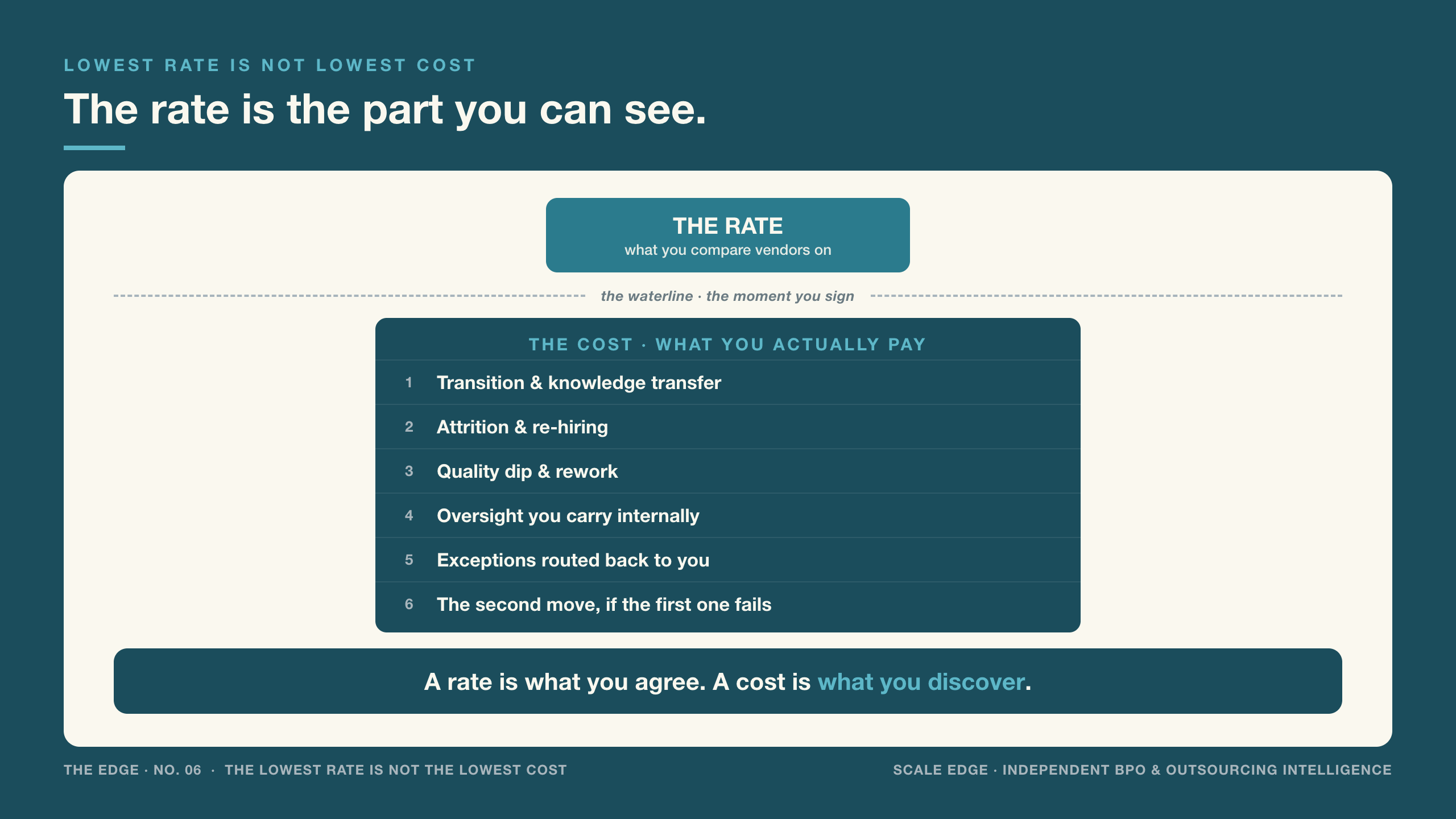
A rate is what you agree. A cost is what you discover.
The number that should be on the page
The reason the cheaper seat keeps winning is that the comparison run at the point of decision is the wrong comparison. Buyers line up rate against rate, because rate is the number every vendor will provide on demand and the number procurement is measured against. The number that actually decides the result is the total cost of delivering the outcome, and it is on nobody's proposal. It contains the rate, and then it contains everything the rate quietly assumes someone else will absorb. Transition, attrition, quality, oversight, exceptions, and the cost of the second move when the first one fails.
Building that number is not complicated, but it does require the buyer to do work the vendor will not do for them. It means writing down the full cost of the relationship as it runs today, including the oversight carried internally and the rework absorbed quietly, and projecting the same full cost for the cheaper option, transition and ramp included, rather than comparing a clean future rate against a messy present one. Run on rate, and the saving is booked the day the contract is signed and unwound quietly over the year that follows. Run on cost to serve the outcome, and the comparison often inverts. Sometimes the cheaper location still wins. Often the seat that looked expensive was the one that delivered the result for less, counted properly. The entire point of the exercise is that you cannot know which until you count the costs that are not on the page.
From the Network
This is the line Scale Edge has spent the past months on, reading live outsourcing contracts against what each buyer was actually promised. The relationships that underdeliver are, with uncomfortable regularity, the ones designed around the rate rather than the result. The rate was negotiated hard, the outcome was assumed, and when the outcome did not arrive the contract had no mechanism to notice it, price it, or recover it. The market is now applying that same lesson to the providers in public, repricing an entire model built on the cheapest seat at scale. Designing a relationship around the outcome instead of the rate is a discipline, and it is the method Scale Edge publishes next. This edition is the reflex. The paper is the alternative.
One move this week
Before your next renewal or vendor comparison, write down the all-in cost of the relationship you have now, not its rate. Add the oversight you actually spend on it, the rework you actually absorb, the escalations that actually reach you, the churn you actually carry. Project the same all-in cost for the cheaper option, with transition and ramp included. Put the two true numbers side by side. If the cheaper rate cannot beat the true cost, and not the rate, of what you already run, it is not a saving. It is a second bill, payable later, and the public markets are currently showing you who pays it first.
Independent intelligence for the buy side of outsourcing. No vendor sponsorship, no commissions, no agenda except yours. Scale Edge tells you what the work should cost, how the contract should be built, and which partner can genuinely deliver, then holds them to it.
If you are pricing, renewing, or rethinking an outsourcing contract this year, talk to someone independent before you sign. The first conversation is free.
Sources
Concentrix second-quarter fiscal 2026 results. Teleperformance FY2024, FY2025 and Q1 FY2026 updates. Share prices from Euronext (Teleperformance, in euros) and Nasdaq (Concentrix and TTEC, in dollars) closing prices, July 2025 to July 2026. The two other top-tier operators, Foundever and Alorica, are privately held and publish no share price.