Every serious outsourcing decision this year is being made partly on a demonstration. A vendor shows an agent that resolves a case on its own, a dashboard that reads a conversation as it happens, a roadmap of what the platform will do in eighteen months. The buyer, reasonably, wants to lock that in, so the contract runs for years rather than months, and the capability that won the deal is written into a commitment that will outlast three budget cycles. What the buyer is actually signing, underneath the capability, is a bet that the vendor selling it will still be there, still own it, and still be investing in it when the term ends. That bet is rarely priced, and the market is making it harder to win.
What the money is actually doing
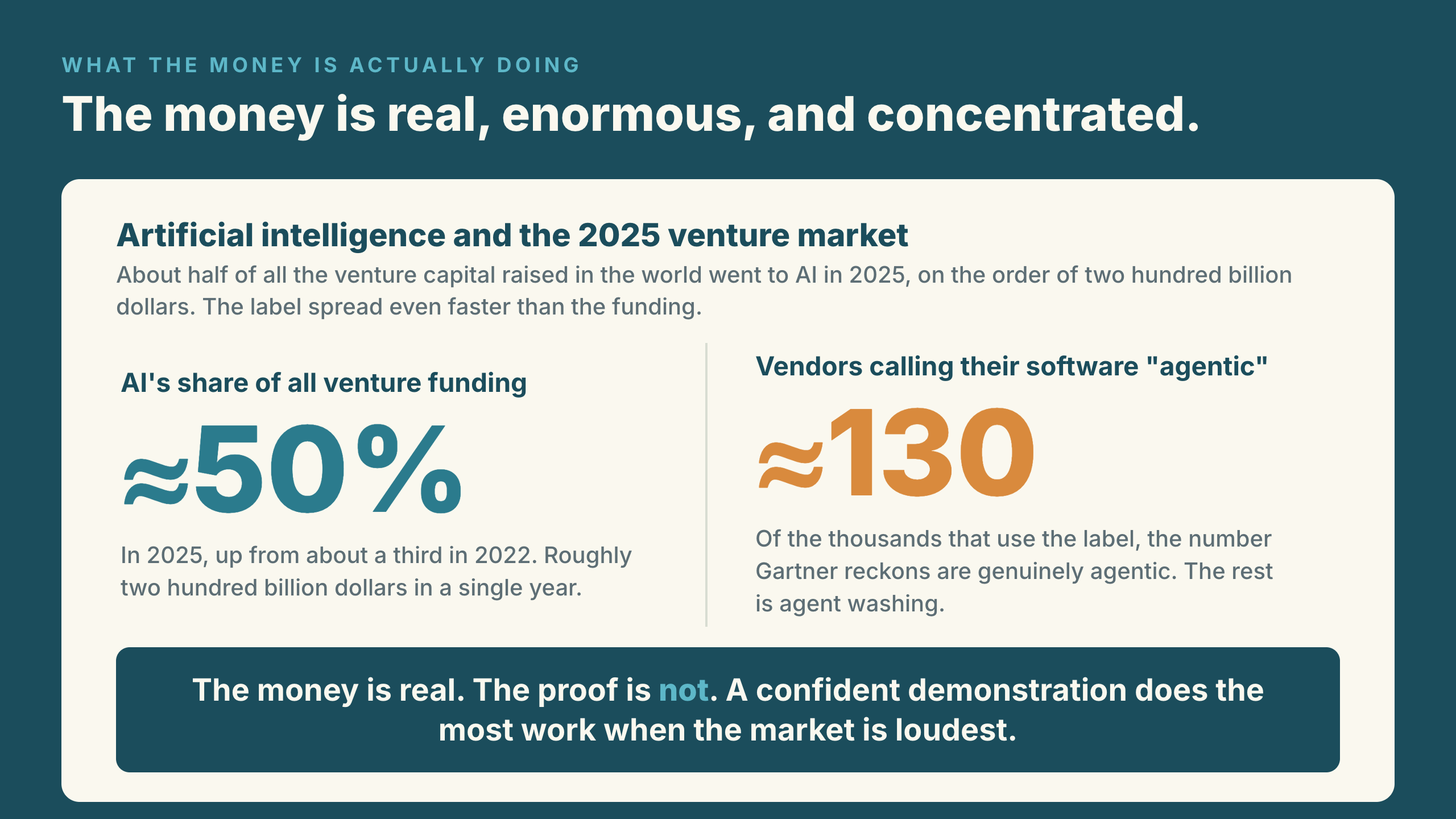
Start with the money, because it explains the noise. In 2025 artificial intelligence took roughly half of all the venture capital raised in the world, on the order of two hundred billion dollars, up from about a third in 2022. The money did not spread evenly. It pooled in a small number of very large laboratories, while thousands of smaller companies competed for what was left. The label moved faster than the funding. Of the many vendors that now describe their software as agentic, the research firm Gartner reckoned in 2025 that only around a hundred and thirty genuinely were, and gave the practice of rebranding old automation as autonomous intelligence a name, agent washing. For a buyer, the immediate problem is not that the technology is weak. It is that the market is loud, crowded, and hard to tell apart from the outside, which is the exact condition in which a confident demonstration does the most work and proves the least.
The shakeout is already visible
The thinning has already begun, in public. Startup shutdowns tracked by the equity-management firm Carta rose about a quarter in 2024 over the year before, and the wind-downs recorded by AngelList rose by more than half. The casualties include names that raised enormous sums on exactly the kind of story a buyer is asked to believe. Builder.ai, once valued above 1.3 billion dollars and backed by Microsoft, filed for insolvency in 2025 after raising more than 450 million. Humane, which raised more than 230 million for an artificial intelligence device, sold its assets to HP in early 2025 and switched the hardware off. The pattern reaches the buyer's own projects, not only the vendors. Gartner expects more than forty percent of agentic AI initiatives to be cancelled by the end of 2027, and at least thirty percent of generative AI projects to be abandoned after the proof of concept. The roadmap that closed the deal is, on those odds, more likely to be paused than finished.
The consolidation is faster than the contract
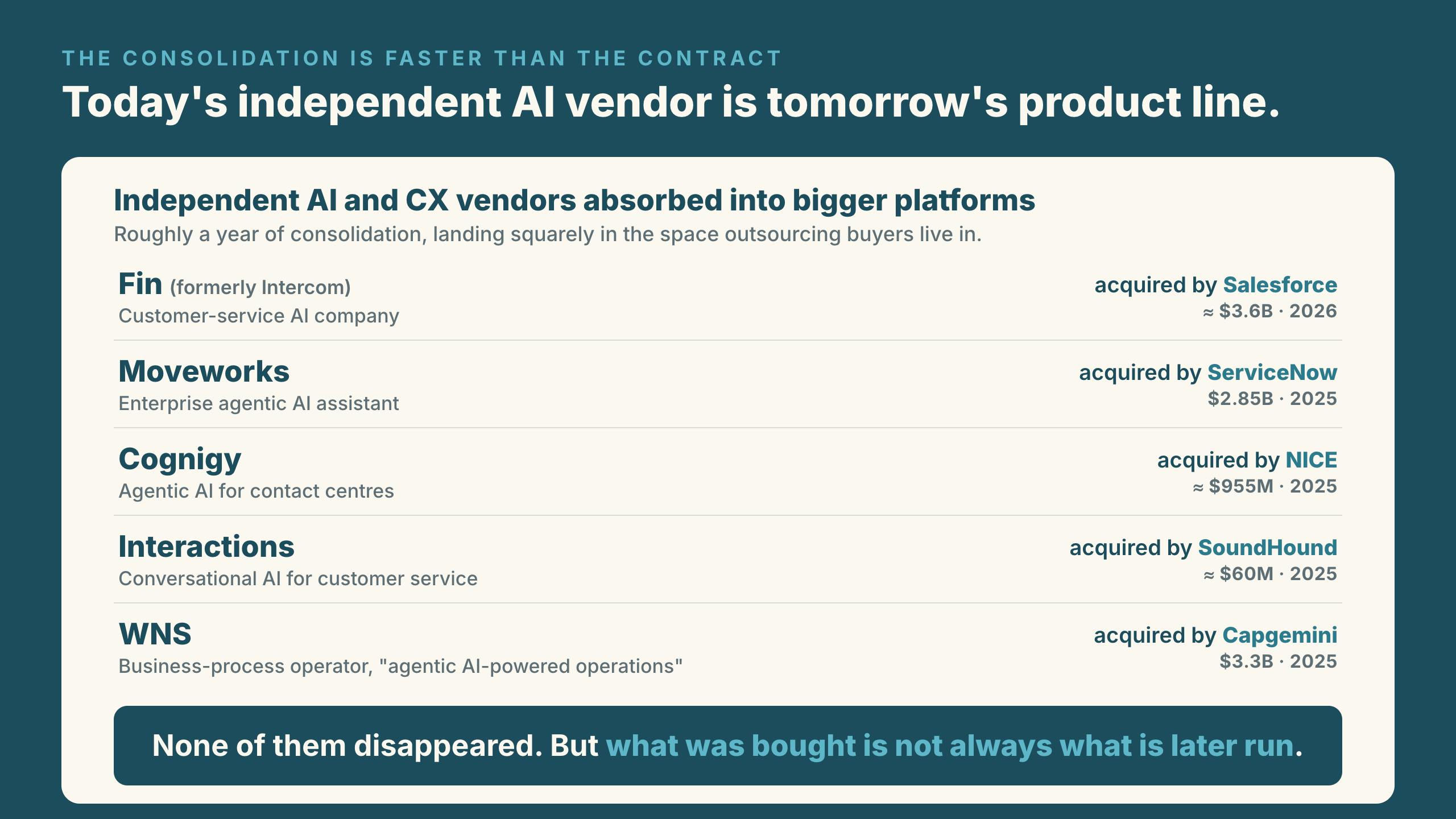
Where a vendor does not fail, it is increasingly absorbed, and this is the part that matters most to a multi-year contract. Acquisitions of artificial intelligence companies rose about ninety percent year on year in early 2026, and the average time from founding to exit has compressed to roughly four and a half years, from more than seven. The consolidation is landing squarely in the customer-experience and contact-centre space that outsourcing buyers live in. Over the past year, ServiceNow bought the enterprise agent company Moveworks for about 2.85 billion dollars. NICE acquired Cognigy, an agentic AI vendor built for contact centres, for about 955 million. SoundHound absorbed Interactions, a conversational AI provider for customer service. Capgemini agreed to buy the business-process operator WNS for 3.3 billion dollars, to build, in its own words, agentic AI-powered intelligent operations. And Salesforce agreed to acquire Fin, the customer-service AI company formerly known as Intercom, for about 3.6 billion. None of these companies disappeared. But the independent vendor a buyer evaluated a year ago is now a product line inside a larger platform, with a different owner, a different roadmap and a different set of priorities. What was bought is not always what is later run.
And the contracts are getting longer
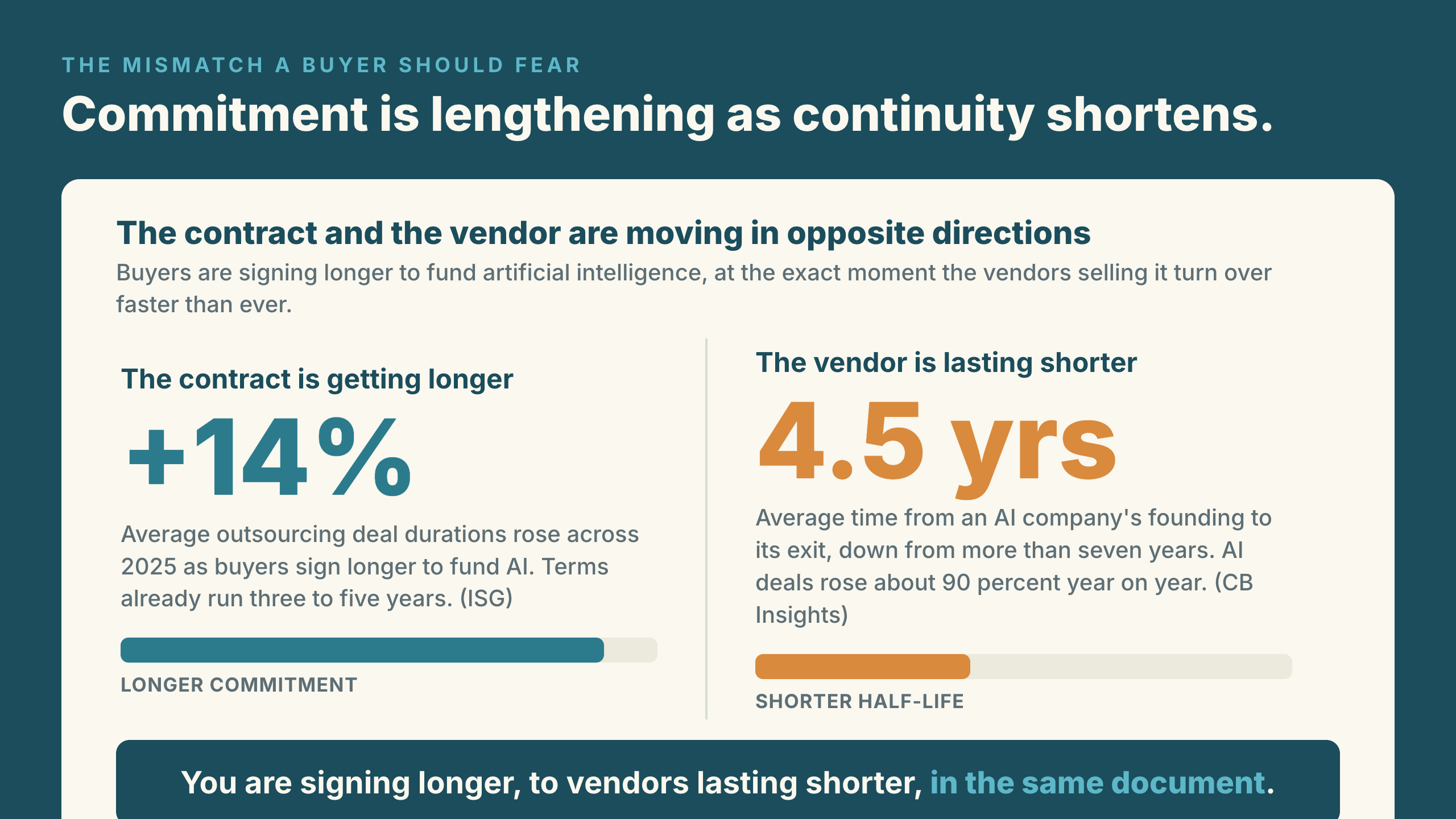
Against all of that movement, the commitment is going the other way. The initial term of a business-process contract is typically three to five years, and in 2025 the terms lengthened rather than shortened. The advisory firm ISG reported that average deal durations rose about fourteen percent across the year, as buyers signed longer agreements specifically to fund artificial intelligence transformation. So the industry has arranged the exact mismatch a buyer should fear. The contract is getting longer at the same moment the vendor's half-life is getting shorter, and the two are being signed into the same document.
You are not buying artificial intelligence. You are buying a better operation. Only one of the two belongs in the contract.
The mistake underneath all of it
Step back from the shakeout and the mistake it exposes is older and simpler than artificial intelligence. Buyers have started to purchase the technology as if the technology were the deliverable. A shortlist gets built around which platform has the most convincing agent, the contract commits years and budget to that platform's roadmap, and the vendor is chosen for the tool it can demonstrate rather than the result it can be held to. No operation was ever improved by a tool it acquired. It was improved by a partner that understood the work well enough to change it, and then delivered a measurable difference in how the work runs. Artificial intelligence, in the hands of a provider that does not understand the operation, transforms nothing. It automates a broken process faster. The buyers losing money right now are the ones who bought an algorithm and expected a transformation, from a vendor that never understood the business it was hired to change.
Contract for the outcome, not the tool
There is a version of the same relationship that is immune to almost everything in this edition, and it is not built on picking the vendor with the most durable artificial intelligence. It is built on paying for the result instead of the method. When a contract is written around an outcome, a resolved case, a lower cost to serve, a shorter handling time, a customer retained, the buyer becomes indifferent to how the vendor gets there. If the vendor uses artificial intelligence, good. If it uses trained people and a redesigned workflow, equally good. If the vendor is acquired, rewrites its roadmap, or loses its funding halfway through the term, that becomes the vendor's problem to solve while still delivering the outcome it was paid for, and not the buyer's problem to absorb. An outcome contract quietly hands the entire survival bet back to the party that should have been carrying it. The buyer stops betting on a technology lasting and starts paying for a result arriving, by whatever means still works.
Writing that contract is less exotic than it sounds, because the machinery already exists. Most agreements already carry service levels, bonus and penalty clauses, and review cycles. The change is what they are attached to. Instead of measuring an activity and hoping it leads somewhere, the contract names the business result the buyer actually wants, fixes the starting point from how the operation runs today, agrees a single trusted way to measure that result, and ties a meaningful share of the fee to whether it moves. The technology never has to be adjudicated. The buyer never has to decide whether the vendor's artificial intelligence is genuine or rebranded, because the contract does not pay for the intelligence. It pays for the number, and the number is either better than the baseline or it is not.
That structure also rewards the only vendor a buyer actually wants, the one that studies the operation, commits to improving it, and agrees to be measured on whether it did. It is worth watching who accepts it and who does not. A provider confident it can transform the business will take a real share of its fee on the transformation, because it expects to earn it. A provider selling a tool will want to be paid for the tool whether or not the tool changes anything, and will call outcome pricing unreasonable, unmeasurable, or premature. That refusal is not an objection to be negotiated away. It is the answer to the only question that mattered. A vendor that will not be paid on the outcome has just told the buyer it is not confident the outcome will arrive, and that is exactly the vendor a multi-year contract should never have been built around.
From the Network
Scale Edge reads live outsourcing contracts against what each buyer was actually promised, and the relationships that fail share a shape. They bought an input, a rate, a headcount, and lately a technology, and they assumed the output would follow. It rarely follows on its own. The relationships that hold are the ones designed around the result from the start, with the outcome named, measured and priced, so the vendor is paid for the change it makes and not the label it carries. That method, built on live contracts rather than opinion, is the subject of the paper Scale Edge publishes next. This edition is the mistake the market is making in public. The paper is the alternative.
One move this week
Before your next contract or renewal, take whatever the vendor is selling, an artificial intelligence platform, a cheaper seat, a larger team, and put one question to it. What measurable outcome in the business will change because of this, and will the vendor be paid on whether that outcome actually arrives. If the vendor will only be paid for the input, the seat, the licence, the roadmap, then the risk of it working sits entirely with you, and the technology in the demonstration is decoration on a bet you are making alone. Move the outcome into the contract, and the bet moves with it, onto the party best placed to win it.
Independent intelligence for the buy side of outsourcing. No vendor sponsorship, no commissions, no agenda except yours. Scale Edge tells you what the work should cost, how the contract should be built around the outcome, and which partner can genuinely deliver it, then holds them to it.
If you are selecting, renewing, or rethinking an outsourcing or artificial intelligence contract this year, talk to someone independent before you sign. <a class="inl" href="contact.html">Talk to someone independent</a>.
The method behind this edition publishes soon.
--- ---
Sources
In 2025 AI took roughly half of all global venture funding, on the order of ~$200bn, up from ~a third in 2022: OECD, "AI firms capture 61% of global VC in 2025" (USD 258.7bn of USD 427.1bn; up from 30% in 2022, Feb 2026); Crunchbase full-year 2025 (~$211bn, ~50%, up 85% YoY). PitchBook/Bloomberg corroborate (~$192.7bn, 52.5%). "Roughly half / ~$200bn" is the conservative cross-source figure. Of the many vendors calling their software "agentic," Gartner reckoned ~130 genuinely were; coined "agent washing": Gartner agentic-AI analysis, June 2025 (via MarTech / Search Engine Land). Gartner: >40% of agentic AI projects cancelled by end 2027; ≥30% of generative AI projects abandoned after PoC (by end 2025): Gartner press releases (agentic prediction 25 Jun 2025; GenAI prediction 29 Jul 2024). Startup shutdowns rose ~25.6% in 2024 (Carta, 966 vs 769); AngelList wind-downs +56.2% (364 vs 233): Carta and AngelList data, via TechCrunch, full-year 2024 vs 2023. Builder.ai: once valued >$1.3bn, Microsoft-backed, raised >$450m, filed insolvency 20 May 2025: TechCrunch / The Register, May 2025. Humane: raised >$230m for its AI device; assets sold to HP for $116m, devices switched off (Feb 2025): TechCrunch, Feb 2025. AI M&A up ~90% YoY in Q1 2026 (266 deals); average time from founding to exit compressed to ~4.5 years from ~7.6: CB Insights, State of AI Q1'26 report. Cognigy (agentic AI for contact centres) acquired by NICE for ~$955m (announced 28 Jul 2025, closed 8 Sep 2025): NICE press release; Calcalist/CTech (verified vs SEC 6-K). Interactions (conversational AI) acquired by SoundHound for ~$60m cash + up to $25m earnout (Sep 2025): SoundHound SEC Form 8-K, Item 2.01. ServiceNow acquired Moveworks (enterprise agentic AI assistant) for $2.85bn (announced 10 Mar 2025, completed 15 Dec 2025): ServiceNow newsroom; BusinessWire completion notice. Capgemini to acquire WNS for $76.50/share, ~$3.3bn cash consideration, "Agentic AI-powered Intelligent Operations" (announced 7 Jul 2025, closed 17 Oct 2025): Capgemini press release (verified vs WNS SEC Form 8-K, Exhibit 99.1). Salesforce agreed to acquire Fin, the customer-service AI company formerly known as Intercom, for ~$3.6bn (announced 15 Jun 2026): Salesforce IR; TechCrunch, 15 Jun 2026. BPO initial contract term typically 3 to 5 years: Lexology, "Outsourcing contracts" Q&A (USA). Average managed-services deal durations rose ~14% across full-year 2025 as buyers signed longer to fund AI transformation: ISG Index, Full-Year 2025 (ISG Chief AI Officer Steve Hall, reported Jan 2026). Lowest-longevity vendor selected on capability alone can leave a multi-year contract exposed on continuity (independent framing): Scale Edge analytical position.