Almost every outsourcing decision of the last twenty years came down, in the end, to a rate. A seat that costs a certain amount in Ohio costs a fraction of that in Manila, the arithmetic is easy, and so the work followed the arithmetic. Delivery geography stopped being a strategic question and became a procurement one, resolved by whichever location produced the lowest cost per seat that still cleared a quality bar. That single decision built an industry measured in millions of jobs. It is also the decision that is quietly coming undone, because the number it rested on is being squeezed from two directions at once, and neither of them is going back.
The number the industry was built on
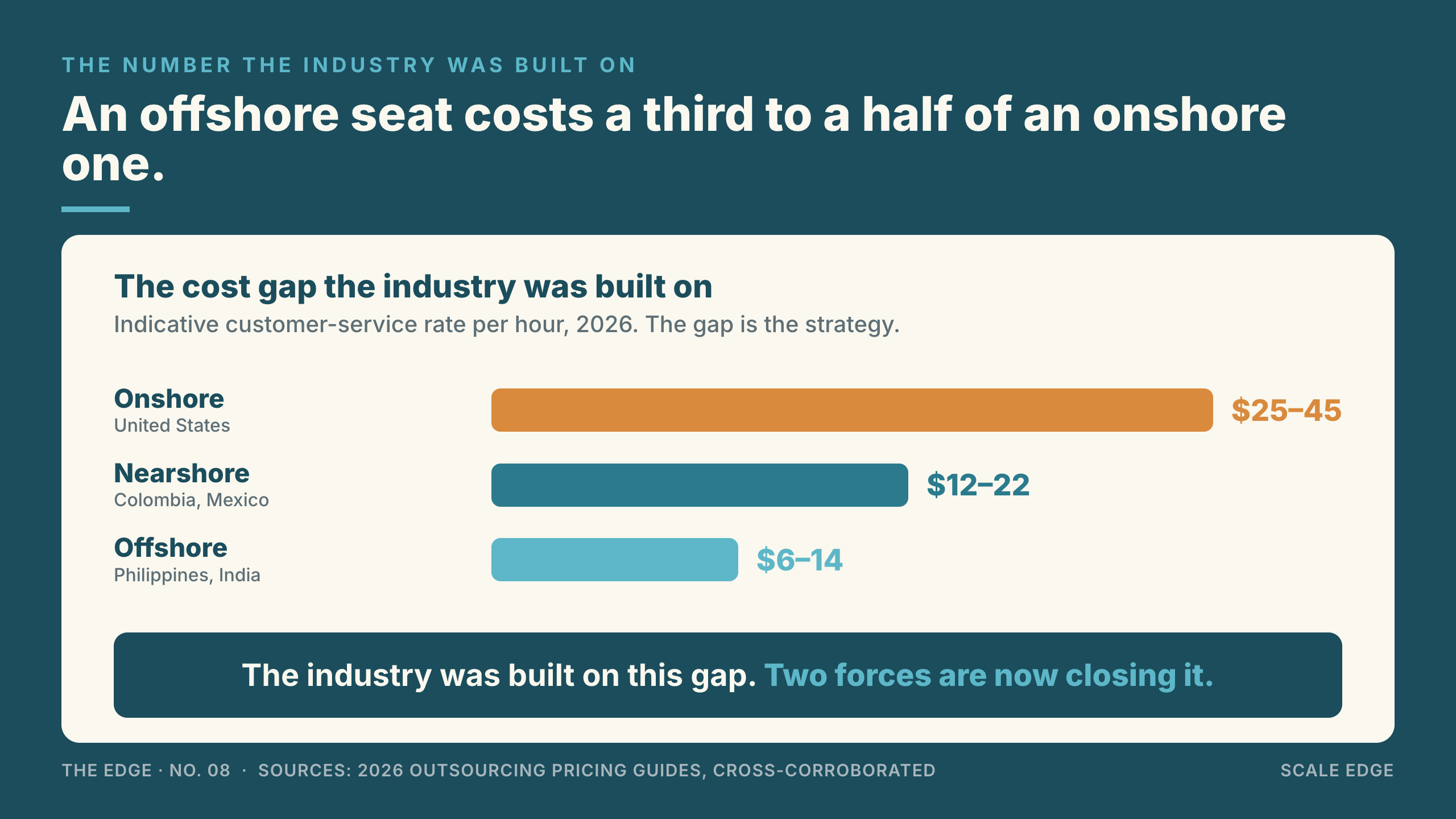
Start with the gap itself, because it explains the map. Published outsourcing pricing guides for 2026 put a customer-service hour in three broad tiers. Onshore in the United States costs roughly twenty-five to forty-five dollars an hour. Nearshore in Latin America, Colombia and Mexico, runs roughly twelve to twenty-two. Offshore in the Philippines and India runs roughly six to fourteen. An offshore seat, in other words, has long cost something like a third to a half of an onshore one, and that difference is the reason the industry sits where it sits. The Philippine outsourcing sector alone employed about 1.9 million people in 2025 and earned around forty billion dollars, more than eight percent of the country's entire economy. India's technology and outsourcing base is larger still, with the business-process segment employing well over a million people inside a wider industry of nearly six million. None of this was built on capability that could only exist abroad. It was built on a discount, and the discount was the strategy.
Regulation is closing the door from one side
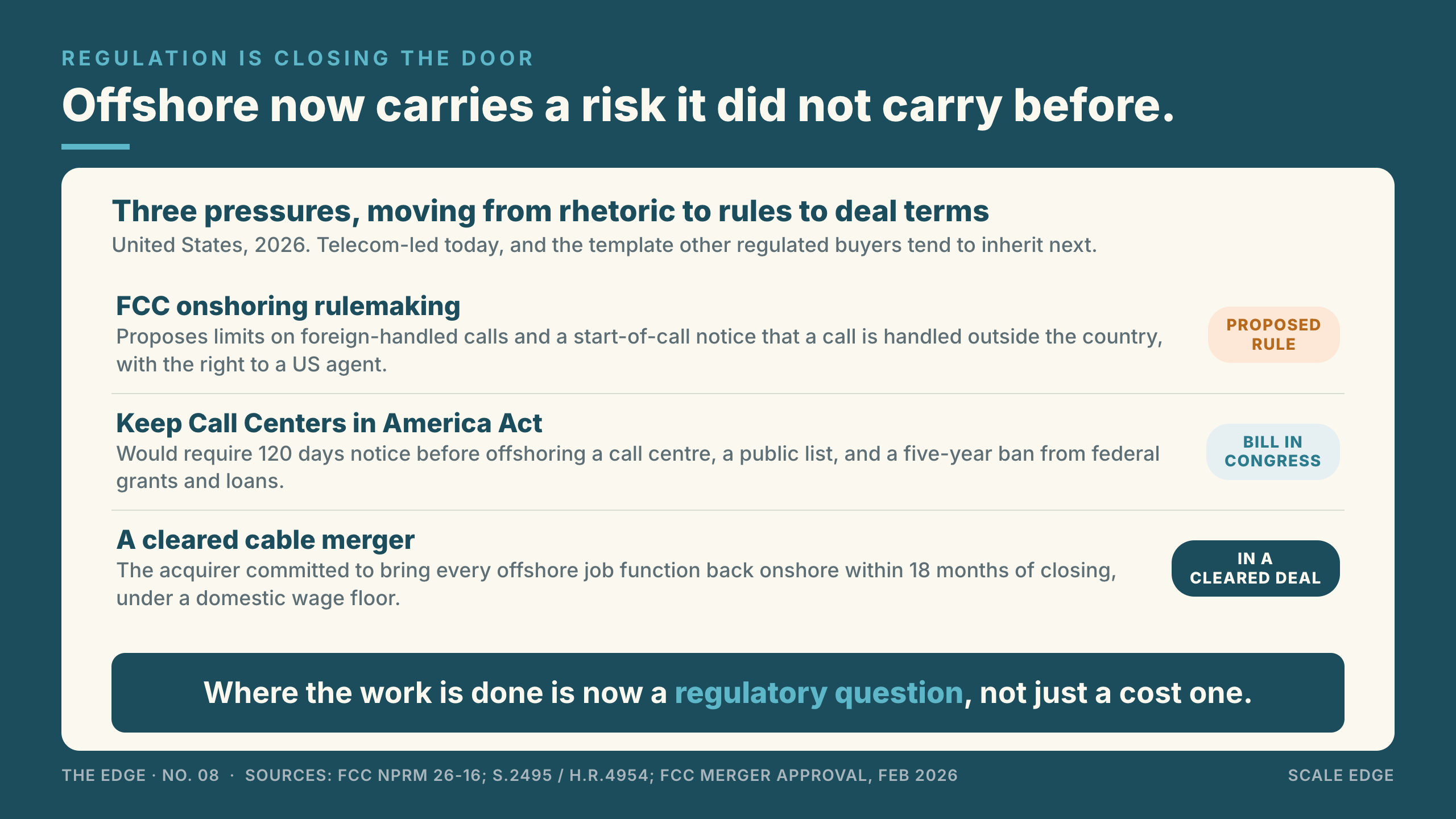
The first squeeze is political, and it has moved this year from rhetoric into rules and deal terms. In March 2026 the United States communications regulator opened a formal proposal titled, plainly enough, improving customer service through onshoring. It asks whether providers should be limited in the share of customer-service calls they may handle at foreign call centres, floats thirty percent as a figure to comment on, and proposes that a customer be told at the start of a call when it is being handled outside the country and be allowed to ask for a domestic agent instead. The regulator governs only communications companies, so the rule it is drafting would bind telecom, broadband and cable providers rather than every outsourcing buyer. It is a proposal open for comment, not a rule in force, and it should be read as direction rather than law. But it is direction, and it is not alone. A bill introduced in Congress in 2025 would require an employer to give the labour department at least a hundred and twenty days notice before moving a call centre abroad, place those that do on a public list, and bar them from federal grants and guaranteed loans for five years. It has not passed, and may not. Yet the same idea keeps arriving from different doors.
And it has already started to appear where it is hardest to ignore, inside the terms of actual transactions. When the communications regulator cleared a thirty-four and a half billion dollar cable merger in February 2026, the acquiring company had committed to bring every job function then handled offshore back onshore within eighteen months of closing, and to put its domestic wage floor under the acquired workforce. That is no longer a survey finding about what buyers say they prefer. It is a binding commitment attached to a deal, and it signals to every large buyer watching that where the work is done has become something a regulator, a board, and a headline will now ask about. Offshore delivery has acquired a category of risk it did not carry a few years ago, and risk is a cost that never appeared on the per-seat rate.
None of this is global, and most of it is not yet binding. It is American, its sharpest edge sits inside a single regulated sector, and two of the three signals are still only proposals. But this is how a shift of this kind tends to begin, in the most consumer-facing and most-regulated corner of one large market, and it rarely stays there. Rules first written for communications providers are the template the other heavy outsourcing buyers tend to inherit next, in financial services, in healthcare, in utilities, and any provider that answers a United States customer already sits inside the reasoning wherever it is based. The direction is set even where the rule is not.
And artificial intelligence is closing it from the other
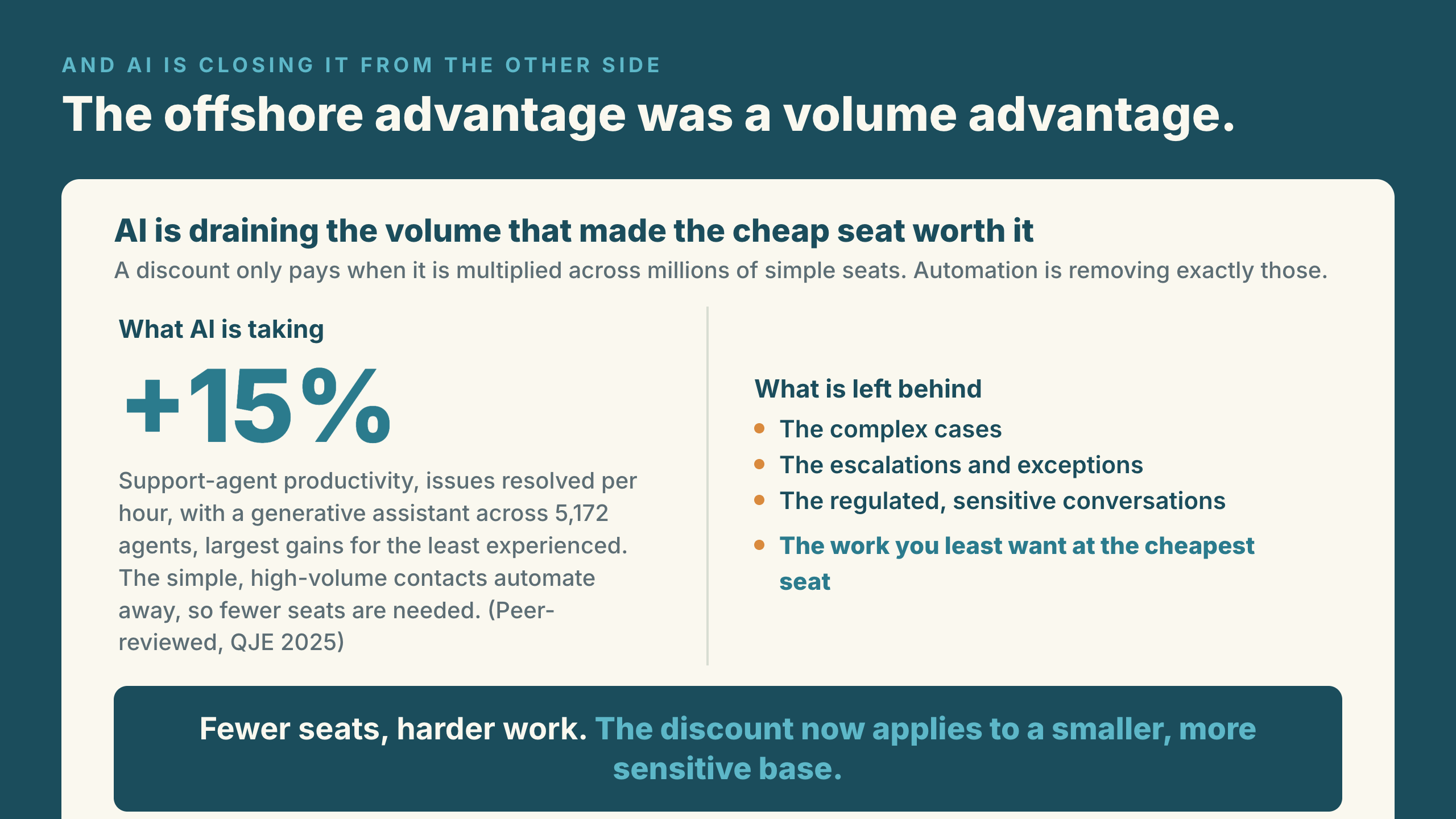
The second squeeze is quieter, and in the long run it matters more, because it attacks not the legality of the cheap seat but the reason the cheap seat existed. It is also the force that respects no border. The regulatory pressure is, for now, an American story concentrated in one sector, while this one applies wherever contact centres exist, because it is not a rule about where the work may be done but a change in how much of the work is left to do. The offshore advantage was never really about location. It was about volume. A discount only produces large savings when it is multiplied across a very large number of seats, and the number of seats was large because contact centres were full of simple, repetitive, high-frequency work. Artificial intelligence is now eating exactly that layer. A peer-reviewed study of more than five thousand support agents found that access to a generative assistant lifted the number of issues resolved per hour by about fifteen percent, with the largest gains among the least experienced staff, and operators deploying the technology in the contact centre report meaningful falls in total call volume and handling time. As the simple contacts are automated away, what remains on the human side is the complex, sensitive, judgement-heavy work, the exceptions, the escalations, the regulated conversations. That is the work a buyer least wants to send to the cheapest available seat. So the volume that made offshore worth the trouble is draining out of the bottom, and the work left behind is precisely the work that argues for keeping it close, capable and accountable. The discount now applies to a smaller and more delicate base, and a smaller discount on more sensitive work is a weaker reason to be anywhere in particular.
You never bought a location. You bought a cost gap, and it is closing from both ends at once.
The mismatch buyers signed into
Set the two forces against how the industry actually contracts and the exposure becomes clear. A business-process agreement typically commits for three to five years, and buyers have been signing at the longer end to fund transformation. So the footprint gets locked, the delivery locations get written into a multi-year commitment, and then the map moves underneath the paper. The regulation that was a proposal at signing becomes a rule mid-term. The volume that justified the offshore seat count halves as automation lands. The buyer is left holding a geography that made sense on the day it was priced and makes less sense every quarter after, in a contract built to make changing it slow and expensive. The industry has arranged for commitment to be longest exactly where the ground is least stable.
The mistake underneath all of it
The shift is uncomfortable, but the mistake it exposes is older than any of this year's headlines. Buyers priced delivery geography as procurement when it was always a decision about risk and capability. Location went into the model as a rate to be minimised, not as a choice with consequences for compliance, for continuity, for how well the hardest work gets done and how defensible it is when a regulator or a customer asks where it happens. Optimised purely for cost per seat, a portfolio ends up concentrated wherever the discount was deepest, which is now also wherever the regulatory exposure is highest and the automation is hollowing the volume fastest. The cheapest map and the riskiest map turned out to be the same map, and very few buyers ever priced the difference, because the spreadsheet only had a column for the rate.
Price the geography, not just the seat
The correction is not a stampede onshore, and anyone selling reshoring as a slogan is selling the same mistake in reverse. It is to treat delivery geography as the decision it always was, with more than one axis. Cost is one axis and still matters. Regulatory exposure is a second, and it now has to be read forward across the life of the contract, not off today's rules. Fit to the work is a third, matching where each kind of task is done to what that task is becoming as automation reshapes it, so that the volume that can be automated is automated and the judgement that remains sits somewhere capable and accountable. Read on all three axes, the answer is rarely all offshore or all onshore. It is usually a deliberate blend, and nearshore often does well in it, because it relieves cost without carrying the far-shore disclosure and continuity exposure and it keeps time zones and language close to the customer. But the specific answer matters less than the discipline. A location chosen on a rate alone is a bet that the rate is all that will ever matter about it, and that bet is now visibly losing.
From the Network
Scale Edge scores outsourcing destinations the way a buyer should, on evidence rather than on a per-seat rate or a vendor's preferred footprint. Each Location Scorecard reads a delivery geography across the dimensions that actually decide whether work should sit there, cost and the real trend in it, talent depth and attrition, language and proximity, infrastructure, and the regulatory and continuity risk that never shows up on an hourly quote. The relationships that age badly are the ones that picked a place for its rate and discovered its risk later. The ones that hold chose the map on purpose and revisited it as the map changed. This edition is the shift now underway. The scorecards are how a buyer reads it before it is written into a five-year commitment.
One move this week
Before your next contract or renewal, ask three questions of your own delivery map, not the vendor's. Where is the work actually done, and what share of it sits offshore. What does the regulatory direction, proposed as well as passed, do to that footprint across the full term you are about to sign. And which parts of the work are volume that automation will take, against which parts are judgement that should be sitting somewhere close and accountable. If those three answers are not in front of you, then the geography in the contract is priced on a single number that is already moving, and the cost of it moving will land on you and not on the vendor that recommended it.
Independent intelligence for the buy side of outsourcing. No vendor sponsorship, no commissions, no agenda except yours. Scale Edge tells you where the work should genuinely be delivered, what it should cost, and which partner can deliver it there, then holds them to it.
If you are selecting, renewing, or rethinking an outsourcing footprint this year, talk to someone independent before you sign. <a class="inl" href="contact.html">Talk to someone independent</a>.
The location intelligence behind this edition is available now.
--- ---
Sources
Indicative 2026 customer-service hourly rates: onshore US ~$25-45, nearshore LatAm ~$12-22 (Colombia ~$12-18, Mexico ~$14-22), offshore Philippines/India ~$6-14; offshore ~a third to a half of onshore: JustCall (12 May 2026); CloudTalk (21 Apr 2026); CallForce Global 2026 pricing guide. Three independent 2026 pricing guides, cross-corroborated. Stated as indicative ranges, not primary statistics. Philippine IT-BPM sector ~1.9 million workers and ~$40bn export revenue in 2025 (~1.82m and ~$38bn in 2024), >8% of GDP: IBPAP, reported by Philippine Daily Inquirer and Philstar (1 Jan 2026); 2024 figures via Philippine News Agency / Tribune (16 Jan 2025). India IT-BPM ~5.8 million employed (FY25); BPM segment specifically ~$49bn revenue (FY24), >1.2 million employed: NASSCOM Strategic Review 2025 (press release); NASSCOM Community (BPM segment, FY24). FCC opened NPRM 26-16 (CG Docket 26-52), "Improving Customer Service and Protecting Consumers through Onshoring," adopted 26 Mar 2026: proposes a limit on the share of customer-service calls handled at foreign call centres (asks whether 30% is appropriate), start-of-call disclosure of non-US handling, right to transfer to a US agent, English-proficiency requirement. Proposed rule, not final; comments closed 26 May 2026: FCC NPRM FCC-26-16A1, paras. 31, 33, 38; Federal Register 23 Apr 2026. Keep Call Centers in America Act of 2025 (S.2495, introduced 29 Jul 2025; H.R.4954, 12 Aug 2025) would require ≥120 days' Labor Dept notice before offshoring a call centre and bar listed offshorers from federal grants / guaranteed loans for 5 years. Introduced bill, in committee, not enacted: Congress.gov S.2495 (119th); GovInfo bill text BILLS-119hr4954ih, Secs. 101(a)(1)(A), 101(b)(1)(A)(i). FCC approved the ~$34.5bn Charter-Cox combination on 27 Feb 2026; Charter's voluntary commitment (acknowledged by the FCC) to onshore all job functions then handled off-shore by Cox within 18 months of close, and to extend its $20/hour minimum wage to Cox workers: FCC News Release DOC-419093A1 (27 Feb 2026); corroborated by Benton Institute and Cablefax. Access to a generative-AI assistant raised support-agent productivity (issues resolved per hour) by ~15% on average across 5,172 agents, largest gains for less-experienced staff: Brynjolfsson, Li & Raymond, "Generative AI at Work," Quarterly Journal of Economics 140(2), 2025. Contact-centre gen-AI deployments report material falls in total call volume (~30% in cases cited) and handle time (>25%); vendor headline deflection rates are frequently overstated: McKinsey & Company, "The contact center crossroads," 2024 to 2025 (used with caveat; QJE +15% is the primary anchor). BPO initial contract term typically 3 to 5 years; buyers signing at the longer end to fund transformation: Lexology, "Outsourcing contracts" Q&A (USA); ISG Index full-year 2025 (durations rose ~14%). Delivery geography is a risk-and-capability decision, not a per-seat rate (independent framing): Scale Edge analytical position.