There is a conversation that happens in outsourcing relationships at around the two-year mark, and it is almost always the same conversation. The buyer sits in the quarterly review, looks at a wall of green metrics, and feels a quiet frustration that the numbers do not explain. Handle time is on target. Quality scores are high. Service levels are met. And yet the customer experience the relationship was supposed to transform looks more or less identical to the day it started. The partner is competent. The partner is reliable. The partner has not changed anything. The buyer concludes, reasonably enough, that they picked a vendor that can only deliver, not one that can transform, and starts thinking about the next selection. Almost always, they are drawing the wrong lesson from the right evidence. The partner did exactly what the contract paid it to do, and the contract never once asked it to transform.
You bought delivery and called it transformation
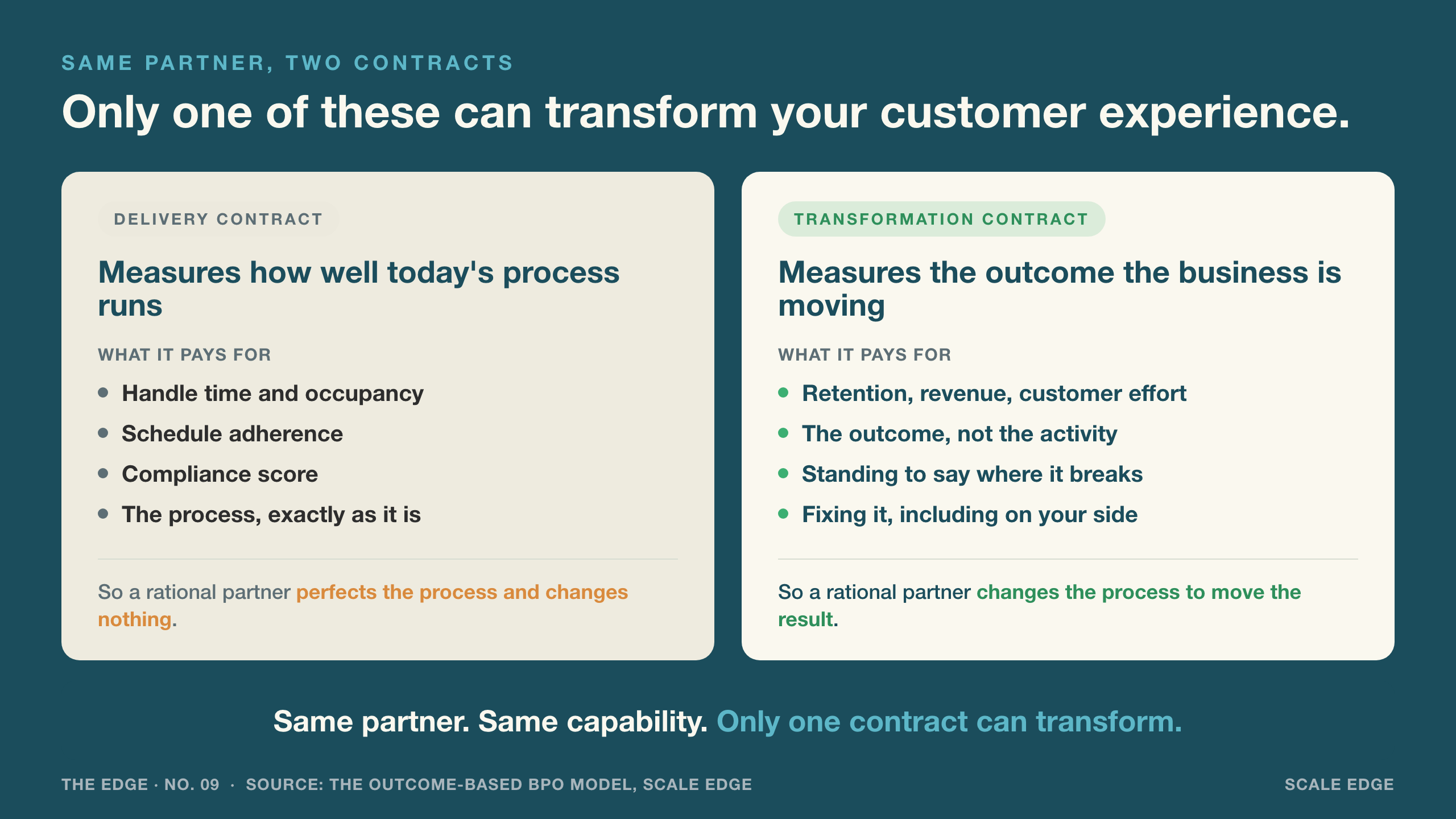
Start with what a standard outsourcing contract actually measures, because that is where the intention and the instruction part ways. The ambition lives in the first pages, in the language about partnership and innovation and continuous improvement. The instruction lives in the schedule at the back, in the list of key performance indicators the vendor is held to and paid against. Almost every one of those indicators measures the same thing, the efficiency of the process exactly as it runs today. Average handle time asks the vendor to run today's call faster. Occupancy asks it to keep today's agents busier. Schedule adherence asks it to staff today's forecast tighter. Quality, in the contractual sense, asks whether the agent followed today's script. Every one of these is a real and useful measure of running the current operation well. Not one of them asks whether the current operation is the right operation, or whether the customer's experience of it improved, or whether the business outcome the buyer actually cares about moved a single point. The contract is a delivery specification wearing the vocabulary of transformation, and when the two conflict, the schedule at the back wins, every quarter, without exception.
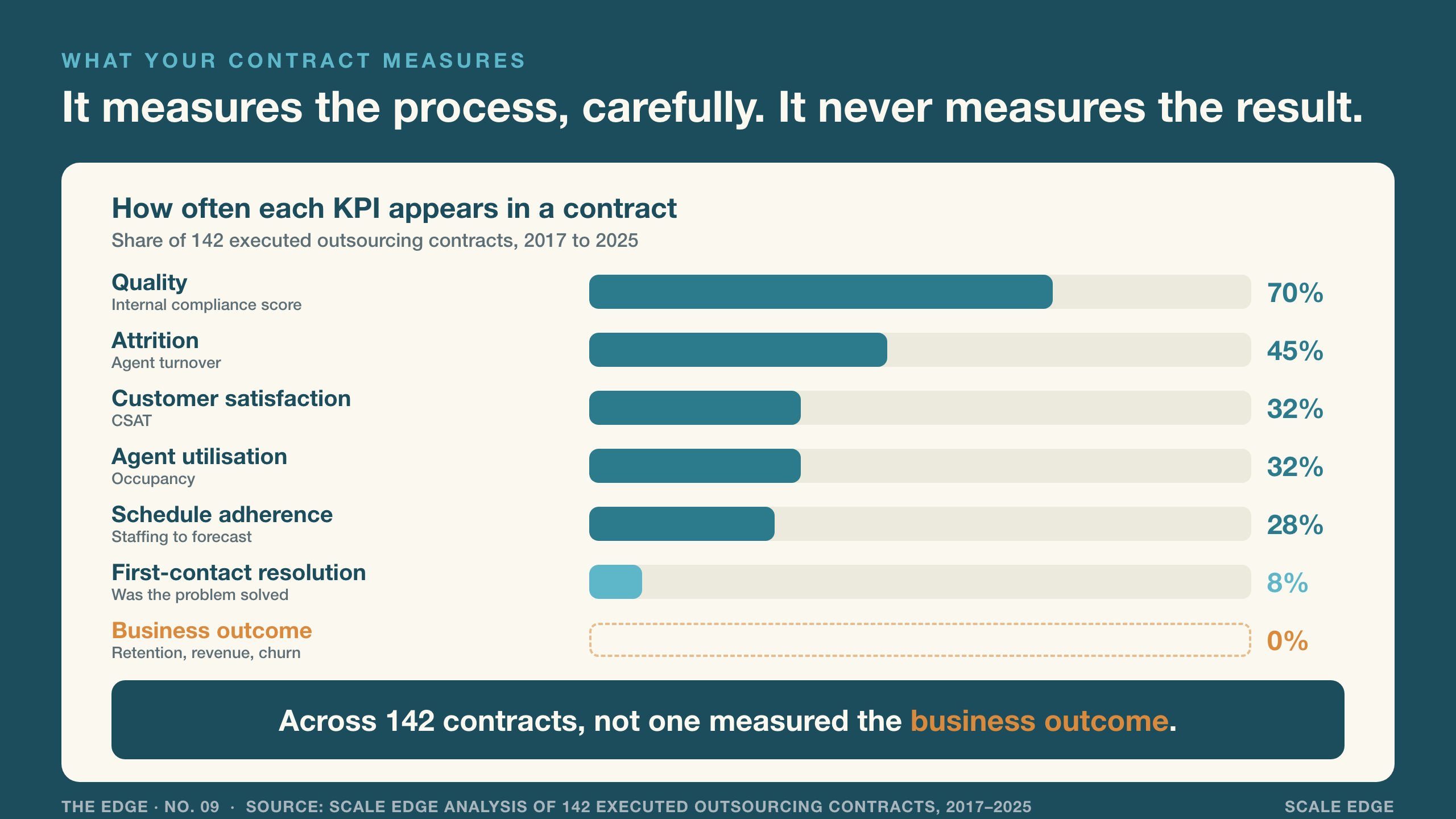
This is not an impression. It is what the contracts say when you read enough of them side by side. Scale Edge has analysed 142 executed contractual instruments signed between 2017 and 2025, of which 53 are independent base contracts and the remainder amendments that inherit their parent's measurement schema. Every prevalence figure below is reported over those 53. The library spans voice and digital service, back office, and specialised operations across ten delivery markets. The single most common performance indicator in that body of contracts is Quality, an internal compliance score measuring whether an agent followed a prescribed rubric. It appears in 70 percent of them. Customer satisfaction appears in 32 percent. First-contact resolution, arguably the closest thing to a measure of whether the customer's problem was actually solved, appears in 8 percent. And a metric that connects directly to the buyer's own business outcome, retention, revenue, churn, the things a board actually asks about, appears in exactly none of them. That holds for the customer-service work this library covers. Contract types built around a business result, from collections paid on recovery to lead generation paid per qualified lead, sit largely outside it. Not one of those base contracts paid its vendor to move the number the buyer was ultimately trying to move.
A good partner will still not transform, because you are paying it not to
Here is the part that surprises buyers most, because it runs against the instinct to blame the vendor. Put a genuinely capable, genuinely well-intentioned partner into a standard contract and it will still not transform your operation, and it will be right not to. Transformation means changing the process, and changing the process is, under a standard contract, an act of self-harm for the vendor. Automate the simple, high-volume contacts and the seat count the vendor bills for falls with them. Redesign a workflow to take a step out of the call and the handle-time and staffing metrics the vendor is measured on move in ways the contract reads as instability before it reads as progress. Suggest that a chunk of the volume should not exist at all, because the product is generating avoidable contacts, and the vendor is arguing itself out of revenue while a compliance metric quietly marks it down for the disruption. A rational partner, looking at the schedule it is actually paid against, keeps the process exactly as it is and runs it beautifully. That is not a failure of capability or of will. It is the predictable, sensible response to the incentives the contract sets. When a measure becomes the target, it stops being a good measure, and every one of these contracts has made the measure the target. You did not choose a partner that cannot transform. Your contract chose stasis on your behalf, and a good partner is simply obeying it.
The money points backwards too
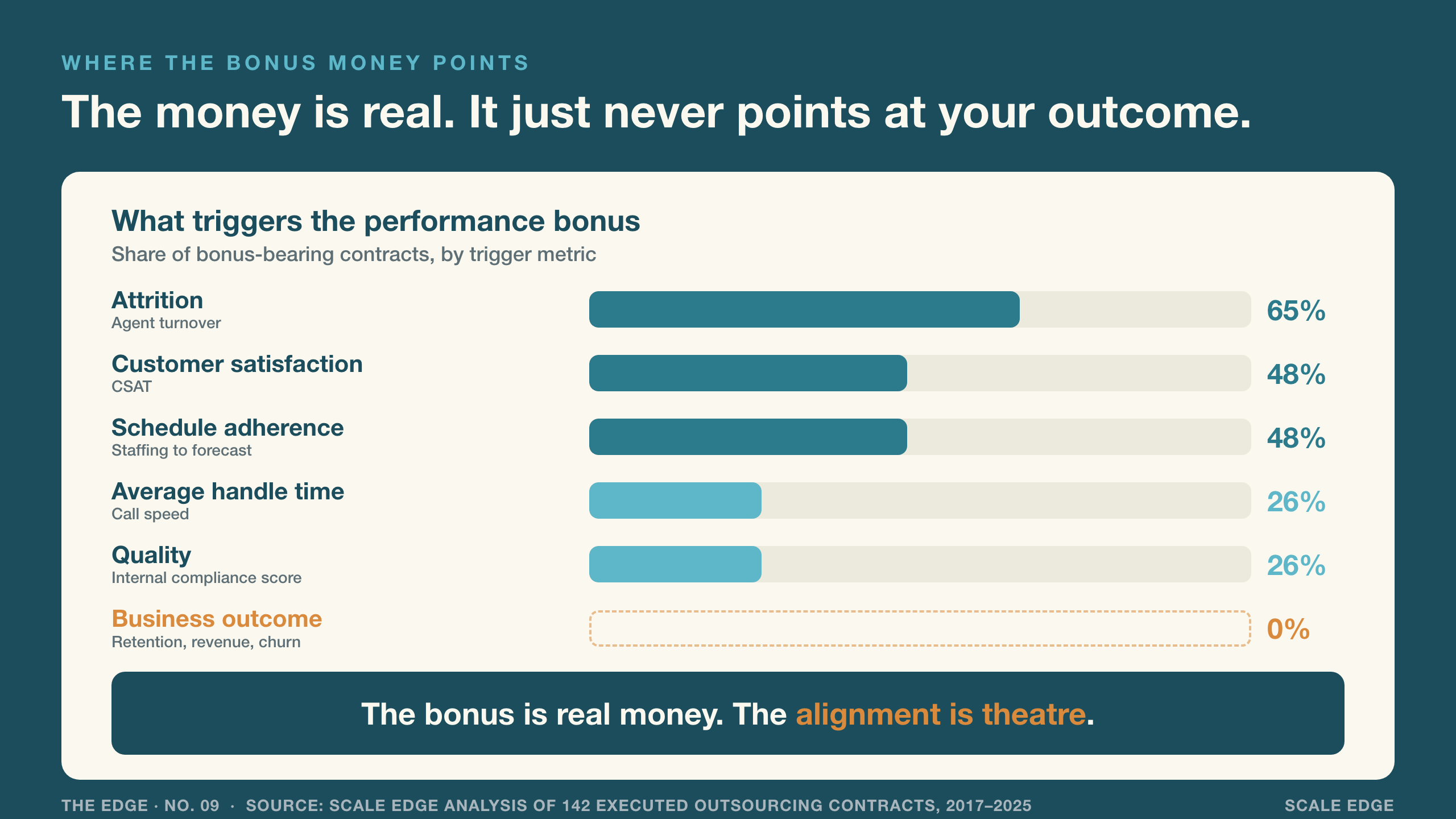
You might expect the commercial incentive, the bonus, to be where transformation gets rewarded, since that is the part of the contract explicitly designed to pull performance upward. It is not. In the same body of contracts, the bonus mechanisms that do exist are almost all pointed at the same operational proxies the base contract already measures. Where a bonus is tied to a trigger, that trigger is attrition in 65 percent of cases, customer satisfaction in 48 percent, schedule adherence in 48 percent. A bonus tied to a customer-side business outcome, the retention or revenue or churn number the buyer actually reports upward, appears in none of them. The extra money, the part of the contract meant to buy something above baseline, buys more of the baseline. It is real money attached to the wrong target. The vendor can earn every bonus in the contract, in full, for three years running, and the buyer's business can be in precisely the same place it started.
A partner is only ever as transformative as its contract pays it to be. Nearly every contract pays for the process to run, and none for it to change.
The barrier you did not expect is your own operation
There is a deeper reason the standard contract holds transformation at arm's length, and it is the reason this is uncomfortable rather than merely technical. Real transformation of a customer experience almost never stops at the vendor's edge. A partner that genuinely set out to improve the outcome would, fairly quickly, run into the parts of the problem that sit on the buyer's side of the line. The product that generates more contacts than it should. The self-service flow that fails and pushes the customer to a human. The internal approval that turns a thirty-second decision into a two-day escalation. The system the agent works in that makes solving the case at first contact impossible. A transforming partner has to be able to point at those things and say, this is where the experience is actually breaking, and it is on your side. A delivery contract never gives it that right, and most buyers, without quite admitting it, prefer things that way. The standard contract lets both parties keep the problem located safely outside themselves. That is its quiet appeal, and it is also why the relationship never changes anything. The barrier to transformation is rarely the vendor's capability. It is a contract that was designed, on both sides, to avoid the buyer's own operation ever coming up.
The fix, in five moves
The correction is not a new vendor, and it is not a longer list of tougher targets, which usually makes the problem worse by nailing the process down harder. It is a contract built backwards from the outcome instead of forwards from the process. Five moves turn a delivery contract into one that can transform.
1. Name the outcome before the KPIs. In one sentence, state the business result the relationship exists to move, the retention rate, the revenue per contact, the customer-effort level, whatever the board is actually asking about. If you cannot say it, no vendor can be paid to move it.
2. Let the partner set the metrics that connect to it. A capable partner understands the link between a daily operational metric and your business outcome in a way a benchmark document never will. Hand them the outcome, ask which indicators drive it, and if they cannot answer, you have learned something important before you signed, not after.
3. Point the money at the result, not the proxy. Take the bonus that today rewards low attrition or a satisfaction score and tie it to the outcome instead. The moment the partner earns more when your business moves, its margin and your result finally pull in the same direction.
4. Write in the right to challenge your own operation. A transforming partner will find the broken flow, the avoidable contact, the two-day approval that sits on your side of the line. Give it the standing to say so, and treat that as the value you are buying, not a complaint to manage.
5. Change what you measure before you change the deal. You do not have to renegotiate the commercial model to start. Replace the KPI schedule at the next quarterly review, with any partner willing to work that way, and let the pricing follow once the measures are right.
From the Network
This edition is a finding from Scale Edge's contract database, not a theory about it. The pattern, that outsourcing contracts measure the process with great care and the outcome not at all, is drawn from 142 executed instruments read side by side, and it is the through-line of the outcome-based model Scale Edge published for the buy side. When Scale Edge reviews a relationship for a buyer, the first question is not whether the vendor is good. It is whether the contract is even capable of producing transformation, or whether it has quietly instructed the vendor to stand still. Most have. The good news in that is practical. If the barrier were the vendor's capability, the fix would be a painful and expensive re-selection. Because the barrier is usually the contract, the fix is in reach, and it starts with reading the schedule at the back of your own agreement as carefully as you read the vendor's pitch at the front.
One move this week
Take your current outsourcing contract and turn to the KPI schedule. Read down the list and ask one question of each line: does this metric pay the vendor to run the process, or to change it. If you reach the bottom and every metric pays for the process to run well and not one pays for the outcome to move, you have found why nothing has transformed, and it is not sitting across the table from you. It is in your own document, in your own signature, and unlike the vendor, it is something you can change before the next renewal.
Independent intelligence for the buy side of outsourcing. No vendor sponsorship, no commissions, no agenda except yours. Scale Edge tells you whether your contract can actually produce the transformation you are paying for, what the outcome should be, and which partner can deliver it, then helps you hold them to it.
If you are selecting, renewing, or rethinking an outsourcing relationship this year, talk to someone independent before you sign. <a class="inl" href="contact.html">Talk to someone independent</a>.
The full analysis behind this edition, <a class="inl" href="outcome-based-bpo-model.html">The Outcome-Based BPO Model</a>, is available now.
--- ---
Sources
142 executed contractual instruments analysed, 2017 to 2025, of which 53 are independent base contracts; voice and digital service ~68%, back office and F&A ~22%, remainder specialised; ten delivery markets: Scale Edge Group primary data (Vault): 142 executed contractual instruments, 43 KPI benchmarks, 18 role families. Documented in The Outcome-Based BPO Model, appendix methodology. Quality (internal compliance rubric) is the most common KPI, in about 70% of base contracts; CSAT 32%; first-contact resolution 8%; attrition 45%; agent utilisation 32%; schedule adherence 28%: Scale Edge analysis of the 53 independent base contracts. The Outcome-Based BPO Model, Parts 1 and 2. No base contract in this customer-service-weighted sample links payment to a customer-side business outcome (retention, NPS/revenue, conversion); Tier 1 outcome drivers appear in zero contracts: Scale Edge analysis of the 53 independent base contracts. The Outcome-Based BPO Model, Parts 1 and 2. Among bonus-bearing contracts (~43% of base agreements carry bonus/malus, typically ~8% at-risk), bonus triggers: attrition 65%, CSAT 48%, schedule adherence 48%, AHT 26%, Quality 26%; business-outcome triggers 0%: Scale Edge analysis of the 53 independent base contracts. The Outcome-Based BPO Model, Part 4. When a measure becomes a target it ceases to be a good measure: Goodhart's Law, via Goodhart (1975) and Strathern (1997), cited in The Outcome-Based BPO Model. Internal QA scores correlate weakly with customer satisfaction (81% of agents' QA scores did not correlate with CSAT): SQM Group, "Call Center Quality Monitoring Best Practices". FTE / headcount-based contracts ~42% of the BPO market, projected to fall to ~28% by 2028 (buy-side shift toward outcomes already underway): HFS Research / Firstsource, "BPO Services-as-Software: Turning Hours into Outcomes," October 2025. Gartner predicted 60% of Finance and Accounting BPO contracts would not be renewed by 2025, citing FTE-based pricing as the primary cause: Gartner press release, 25 May 2021. Outcome-based is a relationship structure, not a payment structure; the real barrier is the buyer's own operation, which the transactional contract lets both sides ignore: The Outcome-Based BPO Model, Scale Edge (conclusions 3 and 5).