The instinct is to blame the technology, or the provider, or the change management. Usually it is none of those. The saving was real. It was absorbed by the commercial structure of a contract signed at a time when nobody was modelling a world with a third less volume in it.
The assumption nobody wrote down
Open any outsourcing contract signed before 2024 and read it as an economic model rather than a legal document. The rate card, the volume forecast, the annual price adjustment, the term length and the exit provisions all rest on one shared premise: that the quantity of work will hold steady or rise. Growth was the only direction anyone needed to plan for, so growth is the only direction the paper handles well. There are usually detailed provisions for what happens when volumes exceed forecast. There is rarely anything comparable for a sustained structural decline.
That was a reasonable way to write a contract for thirty years. Volumes tracked customer numbers, customer numbers tracked the business, and the business was trying to grow. A buyer negotiating hard on the rate was negotiating on the only variable that seemed to be in play.
The variable that is in play now is the quantity, not the rate. And a contract that bills for input has no mechanism for passing that back.
The rate card steps up as you step down
Here is where the saving starts to disappear, and it is the least understood clause in most outsourcing agreements.
Almost all volume-priced outsourcing contracts use a banded rate card. The unit price is not fixed. It is tiered against volume, and the best price sits in the highest band. This is not a trick and no provider hides it. It reflects genuine economics, because fixed delivery costs spread across fewer units really do raise the cost per unit, and a buyer who brings scale really has earned a better rate for it.
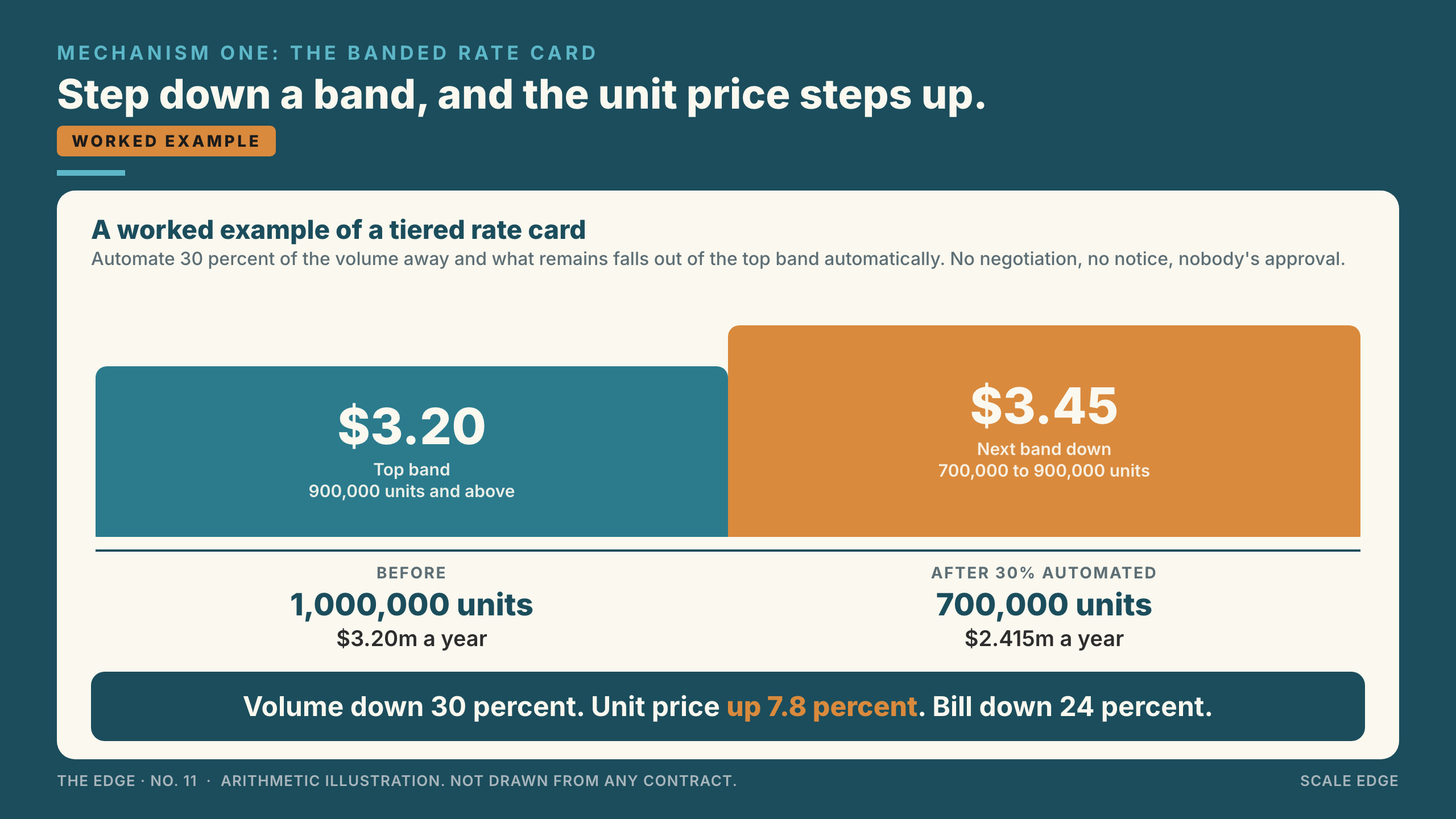
The consequence, though, runs entirely one way. Reduce the volume and the unit price steps up automatically, with no negotiation, no notice and nobody's approval.
Take a programme running 1,000,000 units a year at 3.20 dollars each, with the rate card stepping to 3.45 dollars below 900,000. The annual bill is 3.2 million dollars. Deflect 30 percent of the volume and 700,000 units remain, now priced at 3.45. The bill is 2.415 million. A 30 percent reduction in work has produced a 24 percent reduction in cost, and the price of every remaining unit has gone up by nearly 8 percent.
That first gap is the small one. It is also the only one most buyers model.
The floor you already agreed to pay for
The second mechanism is the minimum volume commitment, and it is the one that does the real damage.
Most contracts of any size include a floor. It appears as a minimum volume commitment, or as a forecast accuracy provision that obliges the buyer to pay for a set percentage of forecast whether or not the work arrives, or as a committed capacity schedule expressed in seats or full-time equivalents. The mechanism differs, the effect does not. Below a certain level of activity, the buyer pays for the level rather than the activity.
Again, there is a legitimate reason for it. The provider hires, trains and holds capacity against the buyer's forecast, and that capacity has a cost the moment it exists. A floor is how the provider is protected against a buyer who forecasts optimistically and delivers less. It exists because buyers have been unreliable forecasters for as long as the industry has been running.
But an automation programme is not a forecasting error. It is a deliberate, permanent reduction, and the floor does not distinguish between the two.
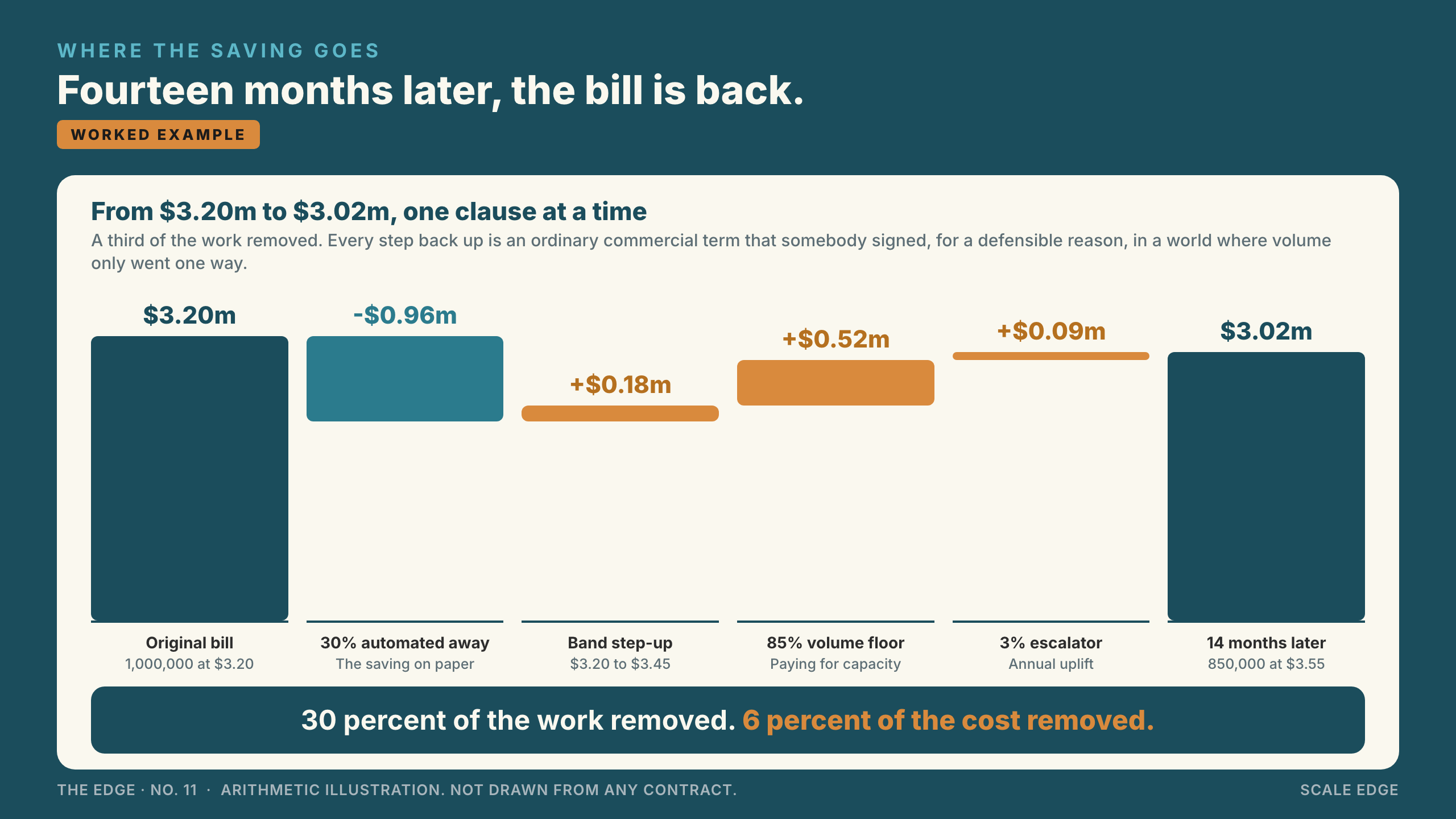
Return to the same programme with an 85 percent minimum volume commitment against the original baseline. 30 percent of the units are gone, but the contract bills for 850,000 of them at 3.45 dollars. The annual cost is 2.93 million against an original 3.2 million. The saving delivered by removing a third of the work is 8 percent of the bill.
The escalator only points one way
The third mechanism finishes the job quietly, over the following year.
Standard practice is an annual price adjustment indexed to inflation, cost of living or an agreed wage index in the delivery country. What is far less standard is a corresponding productivity provision, meaning a contractual expectation that the unit price also falls as the work becomes cheaper to deliver. Where such clauses exist they are frequently soft, expressed as a commitment to discuss continuous improvement rather than as a number that applies automatically.
So the unit price rises every year on a mechanism, and falls only when somebody negotiates it. Apply a 3 percent uplift to the post-deflection rate and the following year the same reduced volume costs a little over 3 million dollars. Fourteen months after removing a third of the work, the bill is within 6 percent of where it started, and the price paid for each individual unit has risen from 3.20 to 3.55, up 11 percent, over exactly the period in which every unit became cheaper to serve.
The percentages are the point, not the size of the example. They hold whatever the contract is worth. On a 30 million dollar agreement, the gap between the saving that was modelled and the saving that arrives is close to 7 million dollars a year.
A contract that bills for capacity cannot pass back a saving that comes from needing less of it. That is not a loophole in the agreement. It is what the agreement says.
This is not one company's bad luck
None of it is theory either. The same structure is visible from the other side of the table, in what the largest providers have just reported, and the way it shows up is instructive, because it does not look like a collapse. It looks like divergence.
Teleperformance reported first-half 2026 revenue down 1.7 percent like for like. Excluding its Trust and Safety business, the same group grew 1.7 percent. One service line moved the entire group by more than three points. Trust and Safety is content moderation, which is precisely the category where volume is handled per unit and where automated classification has advanced fastest. The recurring EBITA margin came in at 13.6 percent, level with the year before, held there by cost discipline and an expanded efficiency programme rather than by the underlying mix.
Concentrix reported second-quarter revenue up 0.6 percent at constant currency, with adjusted EBITDA margin at 14.1 percent against 14.8 percent a year earlier, and cut both its revenue and its earnings guidance. The reason it gave is the one worth reading carefully: an accelerating shift of client work to offshore locations. That is not volume falling. It is the same volume repricing downward, which is the other way an input-priced contract loses value for the provider.
Set those against providers selling something other than handled volume. Genpact reported second-quarter revenue up 7.1 percent and raised its earnings guidance for the year, but the split inside that number is the part worth reading. Its Advanced Technology Solutions line grew 24.1 percent. Core Business Services, which is 73 percent of the company and the part priced closest to the unit, grew 1.9 percent. On the same results the company confirmed it is transitioning out of certain content management work and parts of its contact centre business. EXL reported second-quarter revenue up 15.6 percent, raised its full-year guidance, and now takes a little over half its revenue from data and analytics rather than from operations priced by the unit.
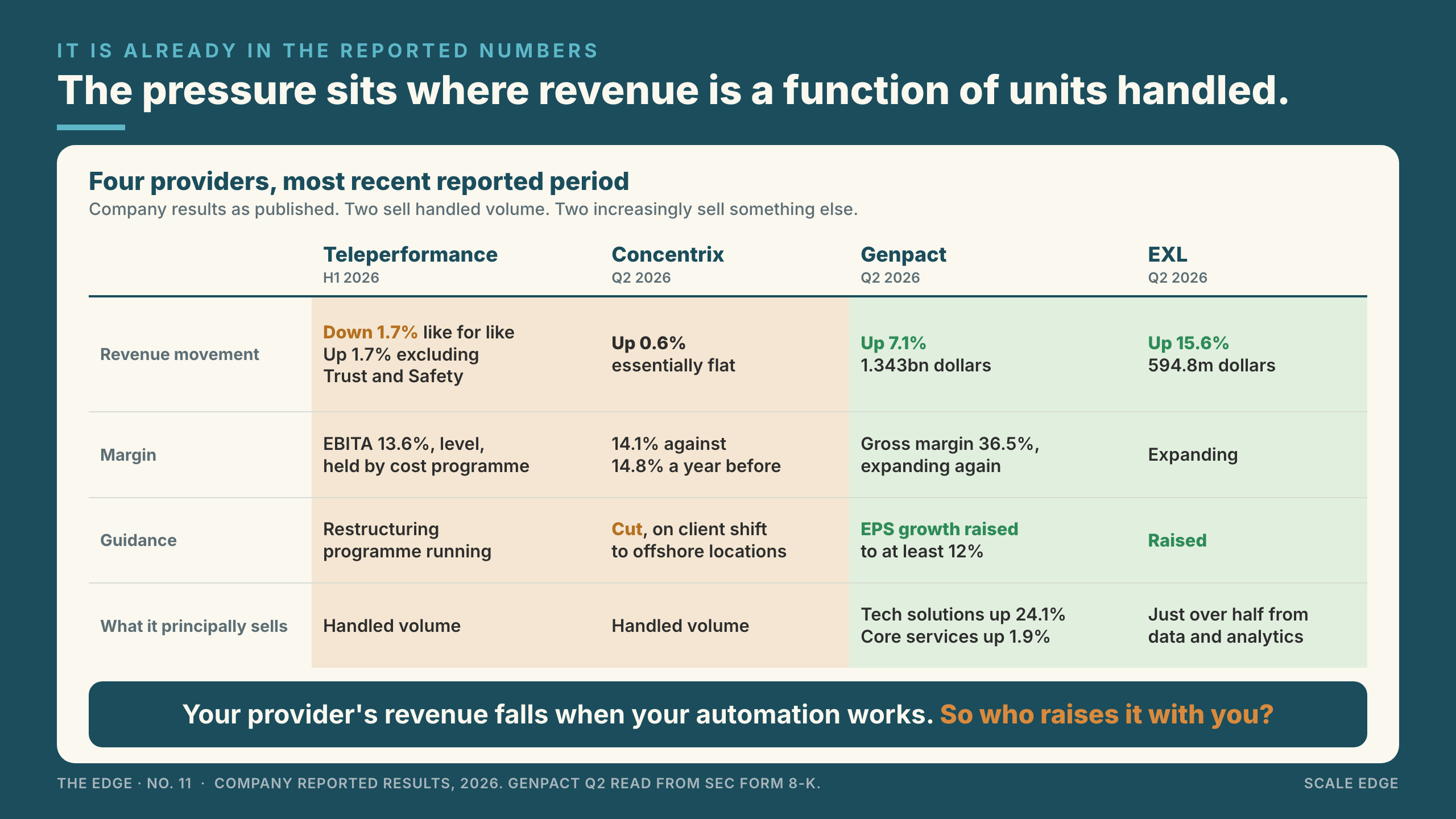
The pattern across those four is not that some providers are better run than others, although some are. It is that the pressure concentrates precisely where revenue is a function of how many units of work arrive. Which is the same structure the buyer is sitting inside, seen from the opposite side.
Nobody in the room is paid to notice
The reason this survives contact with intelligent people is that the three parties who could catch it are each looking somewhere else.
The provider is not hiding it, and in most cases has not thought about it either, because the account team's job is delivery rather than commercial redesign. What is true is that the provider's revenue falls if the buyer's automation succeeds, which means the party with the deepest knowledge of the rate card has no reason to walk the buyer through its behaviour under decline.
The buyer's automation team owns the volume reduction, not the contract. They are measured on units removed, and they remove them. The rate card is somebody else's document.
Procurement owns the contract, signed it two or three years ago, and was measured at the time on the unit rate achieved. By the standard applied then, they did well. The floor and the banding were the concessions that bought the rate down, and they were sensible concessions in a world where volume was going up.
Everybody did their job. The saving still did not arrive.
What it costs a year later
The financial cost is the smaller half. The larger cost is the conclusion the business draws.
A programme that removed a third of the volume and 8 percent of the cost gets written up as underdelivering against its business case. The next round of investment is harder to fund. Somewhere in the organisation a view forms that the automation was oversold, when what actually happened is that it worked and the commercial structure absorbed it. That is an expensive lesson to learn incorrectly, because it is the one that determines what a business is prepared to attempt next.
Five checks to run on your own contract this week
None of this requires a renegotiation to investigate. It requires reading the schedules, which is a shorter job than most people expect.
1. Find the volume bands and locate yourself in them. Establish the current unit price, the band boundaries above and below, and how far the current volume sits from the next boundary down.
2. Run your own automation target through the bands. Take whatever reduction the programme is targeting, apply it to the volume, and read the resulting price off the rate card. Multiply it out. That number, not the volume reduction, is the saving.
3. Find the floor. It may be called a minimum volume commitment, a forecast accuracy provision, a committed capacity schedule or a take-or-pay clause. Establish what it obliges payment for at the reduced volume, and when it resets.
4. Read the price adjustment clause, then look for its opposite. There is almost always a mechanism that moves the price up. Establish whether there is a mechanism that moves it down as the cost to serve falls, and whether that mechanism is a number or a conversation.
5. Check the term against the automation roadmap. Establish the remaining term, the notice period and the renewal date, and set them against when the programme is scheduled to land. A contract that reprices after the volume has gone is a different negotiation from one that reprices before.
Those five answers, on one page, tell a buyer how much of their automation business case the current contract will actually allow through.
From the Network
There is nothing improper in any of the structures described here. Banded rates, volume floors and indexed price adjustments are ordinary commercial terms, they were negotiated openly, and each has a defensible reason to exist. The problem is not that they are unfair. It is that they were all written against an assumption that has now been overturned, and none of them updates itself when the assumption changes.
It is also worth noticing what a provider does when it sees this coming. The ones worth keeping raise it before the automation programme lands rather than after, because they would rather reopen a structure than lose an account at renewal. A provider that says nothing until the invoice conversation has told a buyer something useful about the relationship. That is a fair test to apply to an incumbent, and a fairer one to apply during a selection.
What this leaves is a buyer running a transformation programme against a commercial structure that predates the transformation. Scale Edge works on that gap: establishing independently what a contract will actually pay out under the conditions a business is now creating for itself, and what the market is charging for the same work under structures written more recently. No supplier pays Scale Edge to be listed, rated or recommended.
One move this week
Take the automation target already sitting in this year's plan, find the rate card in the current outsourcing contract, and run that target through the bands and the floor. Do the arithmetic properly rather than estimating it. Most buyers running this for the first time find the gap between the volume they are removing and the cost they are removing is somewhere between two and four times larger than anybody had assumed, and every one of them would rather have found it before the programme reported than after.
Independent intelligence for the buy side of outsourcing. No supplier pays to be listed, rated or recommended, which means turning down the only money in this industry that comes easily.
The Edge publishes every Wednesday. Free, and no vendor has ever paid for a word of it.
If you run the arithmetic this week, send the number over. Scale Edge sees these structures across the market and can tell a buyer whether the gap they found is normal, unusually bad, or already priced into the renewal. <a class="inl" href="contact.html">Talk to someone independent</a>.
--- ---
Sources
Teleperformance H1 2026: revenue 4,883 million euros, down 1.7 percent like for like (down 4.5 percent as reported, on a 1.17 against 1.09 dollar-euro rate); underlying growth excluding Trust and Safety 1.7 percent LFL for the group and 2.3 percent for Core Services; Q2 down 1.2 percent LFL after Q1 down 2.2 percent; recurring EBITA margin 13.6 percent, level year on year, at 662 million euros; efficiency programme expanded to 150 to 170 million euros of annual run-rate savings, 2026 restructuring costs of 120 to 140 million euros: TP press release, 2026 first half results, Paris, 30 July 2026 (tp-press-release-h1-2026-results.pdf, teleperformance.com investor site). Teleperformance restructuring cost of 70 to 90 million euros against a 100 million euro run-rate savings target, Future Forward programme: Teleperformance Q1 2026 release, 28 April 2026. Concentrix Q2 2026: up 1.9 percent reported, up 0.6 percent constant currency; adjusted EBITDA margin 14.1 percent against 14.8 percent; revenue and adjusted EPS guidance cut, EPS by 6.5 percent; cut attributed to accelerating client shift to offshore locations: Concentrix Q2 2026 results, 29 June 2026. Genpact Q2 2026: net revenues 1.343 billion dollars, up 7.1 percent (6.9 percent constant currency); Advanced Technology Solutions 363 million dollars, up 24.1 percent, 27 percent of total; Core Business Services 980 million dollars, up 1.9 percent, 73 percent of total; full-year revenue growth guidance at least 7 percent; adjusted diluted EPS growth guidance raised to at least 12 percent: Genpact Q2 2026 results, SEC Form 8-K Exhibit 99.1, filed 6 August 2026. EXL Q2 2026: revenue 594.8 million dollars, up 15.6 percent reported; full-year guidance raised; data analytics and AI a little over half of revenue: EXL Q2 2026 results, released 28 July 2026 after close. Banded or tiered rate cards, minimum volume commitments, forecast accuracy provisions, committed capacity schedules and inflation-indexed annual price adjustments are standard commercial structures in volume-priced outsourcing agreements: Standard market practice. Described generically, no client contract referenced, no client identifiable, no contract-count statistic used. The worked example: 1,000,000 units at 3.20 dollars, stepping to 3.45 below 900,000; 30 percent deflection; 85 percent minimum volume commitment; 3 percent annual escalator: Arithmetic illustration constructed for this edition. Not observed data, not drawn from any client contract.