
Look at the targets in that contract and ask a simple question about any one of them. Where did this number come from, and what was it validated against?
Nobody chose these
The targets in a typical outsourcing agreement did not arrive from a standards body. There is no committee that sets them, no regulator that publishes them, no research institution that reviews them. They accumulated.
They came out of the operating histories of a very small number of enormous buyers, refined inside those companies over decades against their own products, their own customers and their own definitions of what a good result looked like. Then the industry took the outputs of that process, called them best practice, and put them in the template.
What arrived in your contract was the conclusion of somebody else's twenty-year experiment. Not the experiment. Not the reason. Not the conditions under which the answer held.
What is behind the number, and what is not
Take any single target and follow it back to what has to exist for it to be meaningful.
For a satisfaction target to mean anything, somebody has to have established that satisfaction, measured that particular way, moves the business result you care about. That is not an assumption, it is a piece of work: a survey instrument, a sample, a period long enough to see whether the score and the outcome move together, and a team to keep checking as the product and the customer base change.
For a resolution target to mean anything, somebody has to have defined what resolved means for your operation, distinguished it from closed, and built the measurement that can tell the two apart at volume.
For a quality score to mean anything, somebody has to maintain the rubric it scores against, calibrate the people applying it, and periodically test whether a high score corresponds to anything a customer would recognise as a good experience.
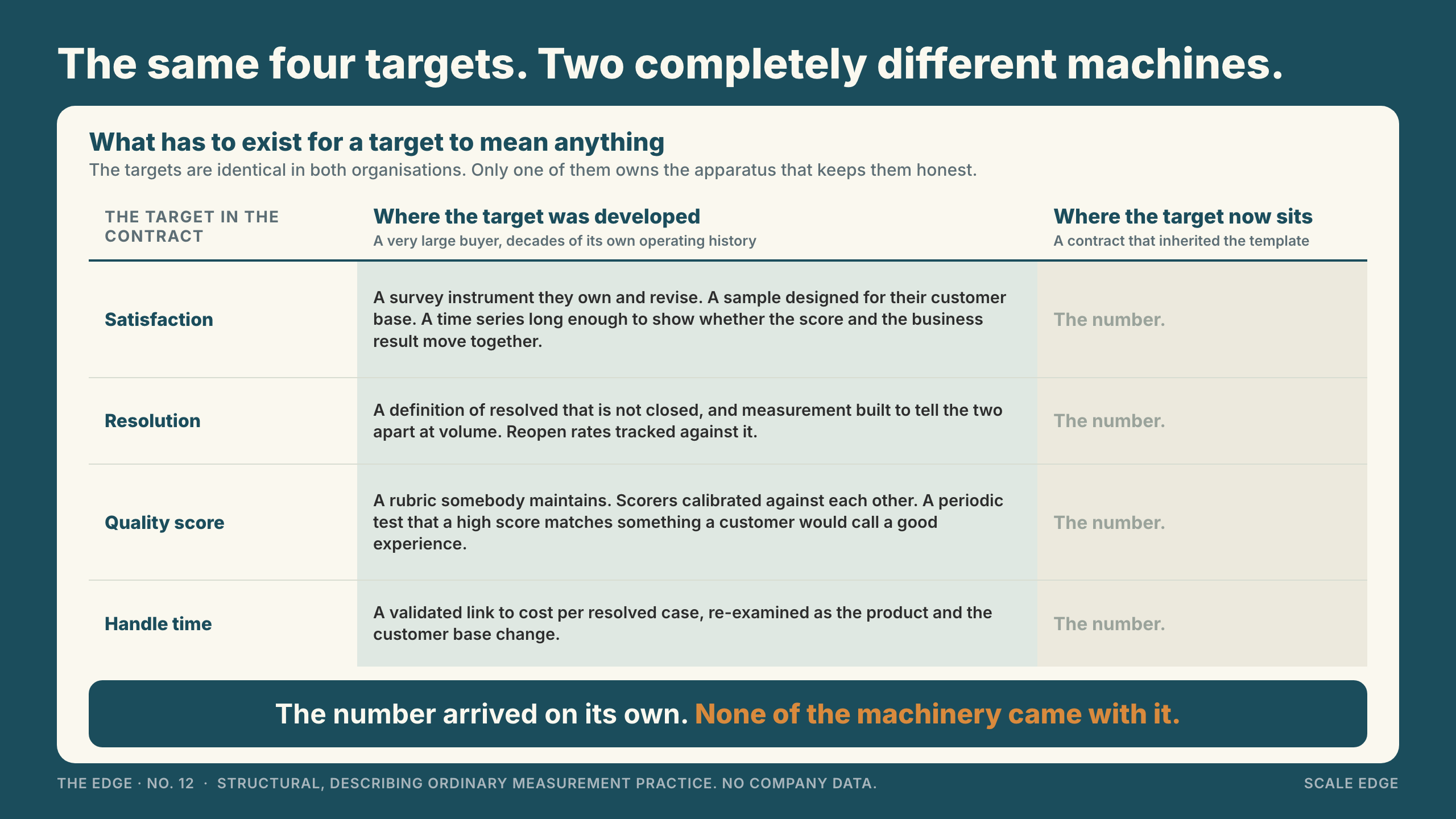
In the companies where these targets were developed, every one of those functions exists and is staffed. There are people whose entire job is to keep asking whether the metric still tracks the outcome, and to change it when it stops.
In the contract that inherited the targets, none of that came along. The number arrived on its own.
You did not inherit a standard. You inherited someone else's operating history with the reasoning stripped out.
Why more vendor managers will not fix it
Almost every buyer who recognises this problem reaches the same conclusion, and it is the wrong one. They assume it is a maturity gap. They are early, the sophisticated buyers are ahead, and the answer is to build up the function over time.
That reading is comfortable and it is worth examining, because it has a consequence. If it is a maturity gap, the correct response is patience and gradual hiring. If it is not, patience is the expensive option.
Consider what closing the gap would actually mean. It is not one appointment. It is a measurement function, an analytics capability, an instrument that can tell you whether the score relates to the result, and enough time series to know the difference between a real movement and noise. In the organisations that built these frameworks, that apparatus employs more people than most buyers have in the entire outsourced operation.
This is not a maturity gap you can hire your way out of.
The organisations that made these numbers work did not solve the underlying problem. They surrounded it with enough resource to absorb it. That is a very different achievement, and it is not one that gets smaller when copied downward.
What the inherited framework costs
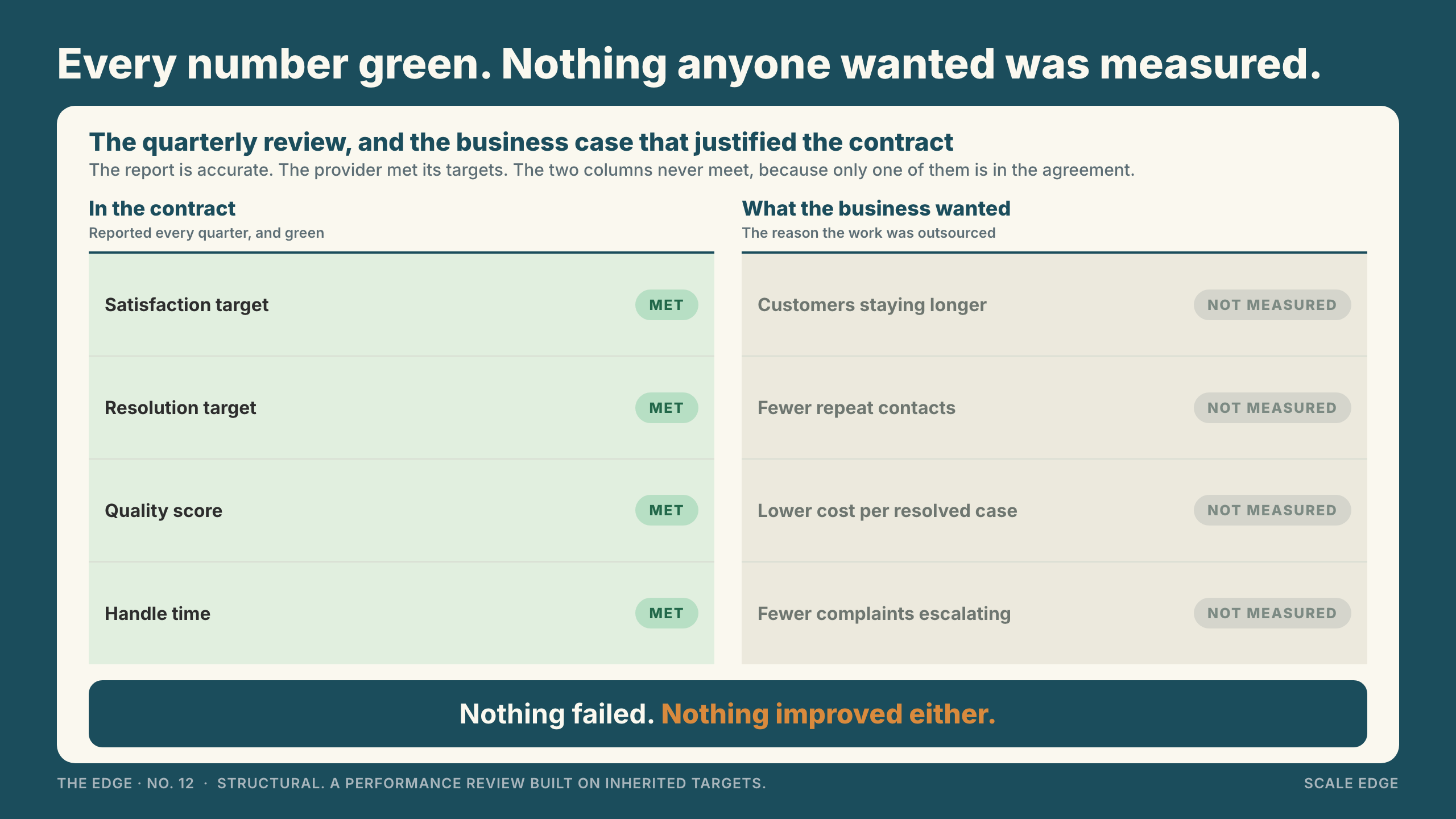
The first cost is that the review has nothing to do. A performance conversation built on inherited targets can establish whether the provider hit the numbers. It cannot establish whether hitting them was worth anything, because nobody ever tied the numbers to a result. So the meeting reports, and the meeting ends.
The second cost is that disagreement has nowhere to go. When a buyer feels the relationship is underdelivering and the metrics say otherwise, there is no evidence available to either side. The provider points at the contract, correctly. The buyer points at a feeling, which loses. What follows is usually a slow deterioration that both parties later describe as a culture problem or a communication problem, when it was a measurement problem the whole time.
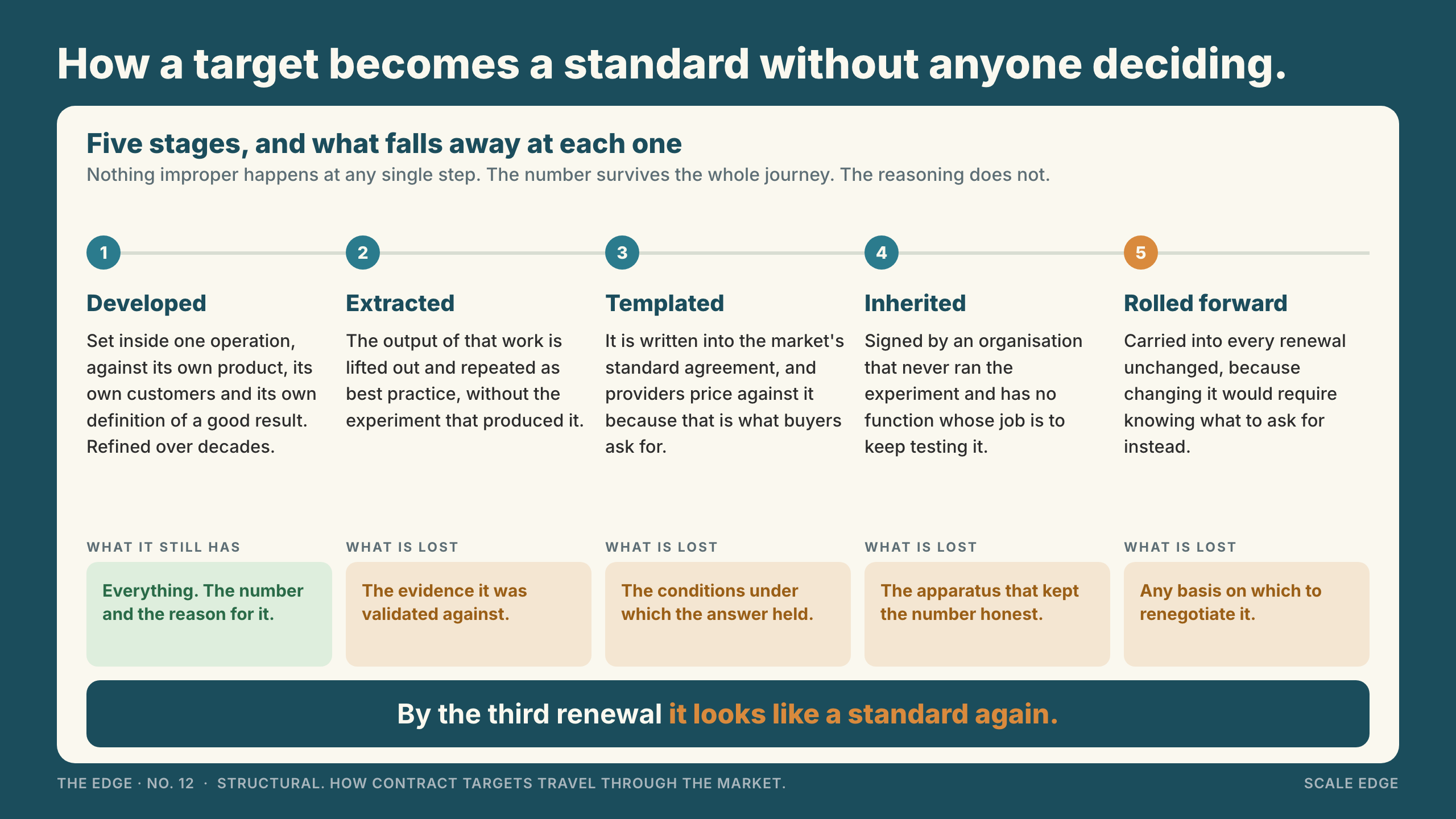
The third cost is the one that shows up years later. A framework nobody chose is a framework nobody can renegotiate, because renegotiation requires knowing what you would ask for instead. So it gets rolled forward at every renewal, and each rollover makes it more established, and by the third term the numbers have been in place so long they look like a standard again.
What the provider is doing while this happens
Nothing improper, and this is the part buyers most often get wrong.
A provider given a set of targets will manage to those targets. That is not cynicism, it is competence, and it is what a buyer is paying for. If the contract says the score is what matters, the score is what a well-run provider will deliver, and it will deploy real skill to deliver it.
The gap between hitting the target and improving the operation is not the provider's to close. They did not choose the measure. In most cases they inherited the same template from the same market, and their commercial teams price against it because that is what buyers ask for.
A provider worth keeping will say so. Not in the quarterly review, where the incentive is to report green, but during a selection or a renewal, when asked directly what they would measure if the choice were theirs. The answer to that question tells a buyer more than any reference call.
Five questions to take into your next review
None of this requires new instrumentation to investigate. It requires asking where the existing numbers came from.
1. Pick your primary KPI and trace it. Ask internally who set the target, in which year, and against what evidence. If the answer is that it came from the provider's template or a previous contract, that is the finding.
2. Ask what business result it is standing in for. Not what it measures, what it is a proxy for. Retention, revenue, cost per resolved case, complaint volume. If nobody can name the result, the metric is unattached.
3. Check whether anyone has tested the link since it was set. Ask when the relationship between that metric and that result was last examined, and by whom. In most operations the honest answer is never.
4. Look at what the target has done over three years. A number that has not moved is usually not a stable operation. It is a target that was set where the operation already was, and has been reported ever since.
5. Ask your provider what they would measure instead. Put it in writing, during a renewal or a selection, and give it a date. A provider with a view will have one. A provider without a view is telling you something useful.
Those five answers fit on a page, and they establish something more valuable than any benchmark: whether the numbers in your contract were ever chosen, or simply inherited.
From the Network
None of this is a criticism of the metrics themselves. Handle time, resolution and satisfaction measures are useful instruments, developed carefully by people solving real problems, and they still do useful work when they sit inside the apparatus that keeps them honest.
The error is not in the numbers. It is in the transfer. A measure validated in one operation, against one product, for one definition of a good outcome, was copied into contracts whose conditions have nothing in common with the original, and the copying was so widespread and so uncontested that it now looks like a standard rather than an inheritance.
What that leaves is a buyer holding a framework nobody in their organisation chose, cannot defend, and has no basis to change. Scale Edge works on that gap: establishing independently what a contract is actually measuring, whether those measures connect to the result the business is trying to produce, and what the market is now writing into agreements drafted more recently.
One move this week
Take the primary KPI in your largest outsourcing contract and ask three people who own it where the target came from. Not what it measures. Where the number came from, and what it was validated against. Ask the operations lead, the person who signed the contract, and the provider's account manager.
Most buyers doing this for the first time find that all three answers are different, and that none of them is a business decision.
Independent intelligence for the buy side of outsourcing. No supplier pays to be listed, rated or recommended, which means turning down the only money in this industry that comes easily.
The Edge publishes every Wednesday. Free, and no vendor has ever paid for a word of it.
If you ask those three people this week, send the answers over. Scale Edge sees what these frameworks look like across the market and can tell a buyer whether what they found is normal, unusually loose, or already a problem at the next renewal. <a class="inl" href="contact.html">Talk to someone independent</a>.
--- ---
Sources
KPI targets in outsourcing agreements are not set by any standards body, regulator or research institution: Structural claim. No standards body publishes BPO KPI targets; the article asserts absence rather than a positive fact. Handle time, resolution and satisfaction measures developed inside large buyer operations and were then generalised into contract templates: Described generically, no company named. Victor's ruling 13 Aug: no buyer named as an exemplar in this edition. Google and Meta excluded outright; any other name waits for the Ed14 research to clear the NCI evidence bar. The functions required for a target to be meaningful (survey instrument, sample, time series, calibration, rubric maintenance): Description of ordinary measurement practice, not a claim about any organisation. Provider behaviour: managing to contracted targets, pricing against the market template: Standard market practice, described generically, no client or provider identifiable.